
Aufgabenstellung 1.2
Themenschwerpunkte: Saving the planet Nations between tradition and change – USA The impact of the media on society Aims and ambitions
Outline the information on the Dakota Access pipeline and the resistance to it.
Analyze how indigenous people are portrayed in the article. Focus on communicative strategies and use of language.
Choose one of the following tasks:
"My job as a photographer is to show people something they’ve maybe never seen before, or show something in a new way, to create greater empathy and compassion and to expand people’s knowledge of our world.” (ll. 53-55)
Taking the quotation and the photograph as a starting point, assess to what extent the perception of global challenges is shaped by visuals in media coverage.
OR
The New York Times has invited young people to take part in its annual Students Editorial Contest and hand in articles about issues that matter to them.
You have decided to hand in an article commenting on the potential youth protests have in drawing attention to environmental issues. Write this article.
Weiter lernen mit SchulLV Plus!
monatlich kündbarSchulLV Plus-Vorteile im ÜberblickDu hast bereits einen Account?Graeme Greene: A Native American faces tear gas, baton charges
and rubber bullets – Camille Seaman’s best photograph
Graeme Greene based this article on an interview with photographer Camille Seaman in
which she talks about the context of her best picture.
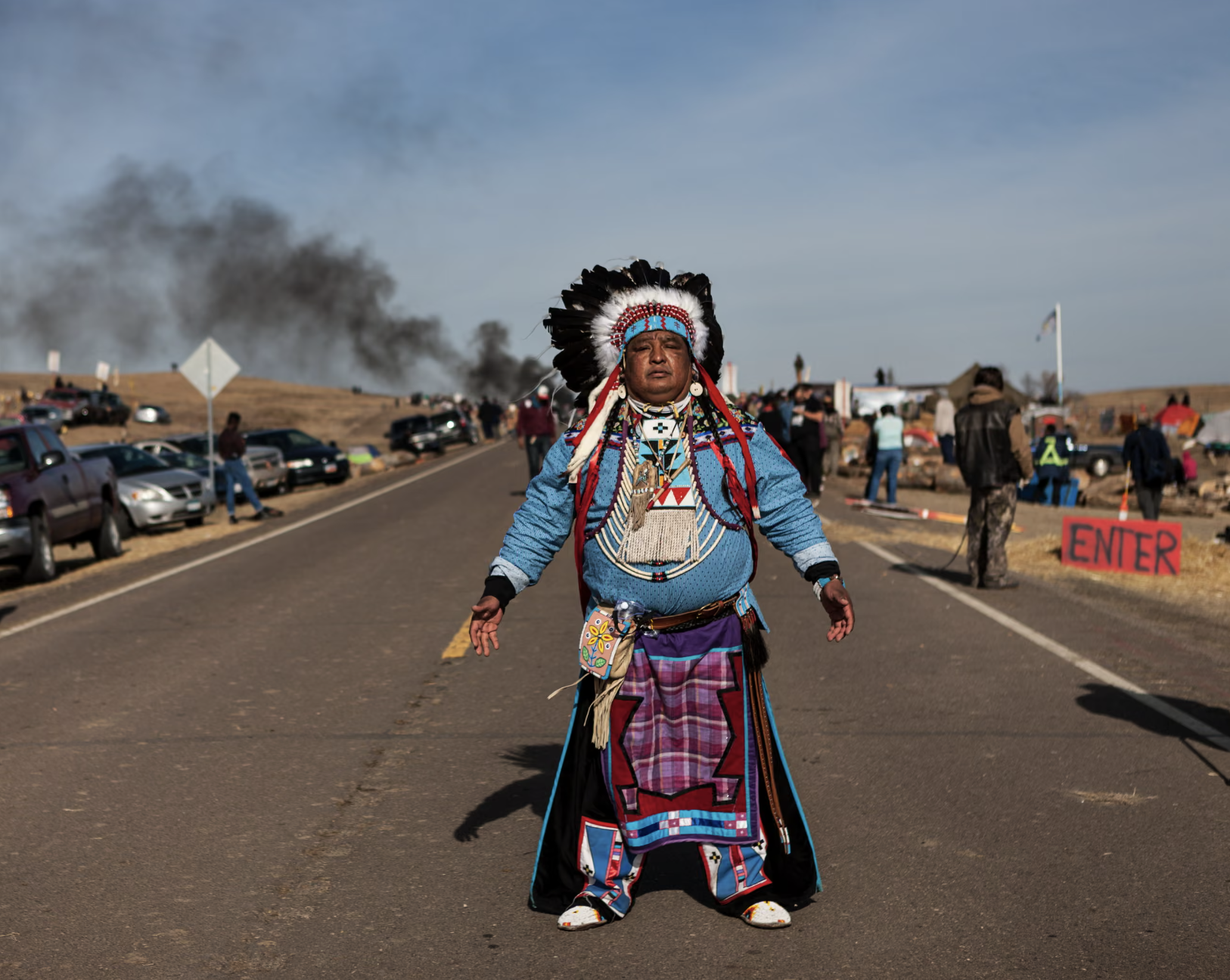
‘If people needed help, he was there’ … Dan Nanamkin, from the Colville Confederated Tribes.
Photograph: Camille Seaman
Source: Green, Graeme. “A Native American faces tear gas, baton charges and rubber bullets – Camille Seaman’s best photograph.” The Guardian. May 4, 2022. Accessed on September 5, 2022.
(Minor spelling mistake in the original corrected.)
Weiter lernen mit SchulLV Plus!
monatlich kündbarSchulLV Plus-Vorteile im ÜberblickDu hast bereits einen Account?Task 1
-
The article presents the conflict surrounding the Dakota Access Pipeline (DAPL) as both an environmental controversy and a continuation of historical injustice toward Native American communities.
-
At the outset, the author situates the conflict within a long history of broken promises: although “hundreds of treaties” were made with Native peoples, “not one – not a single one – has ever been upheld” (ll. 1–2). The emphatic repetition underlines systemic betrayal. Even reservations that were promised to last “for time immemorial” have continually diminished, as the land “always shrinks and shrinks” (ll. 2–3), suggesting ongoing dispossession.
-
In 2016, a “massive protest” (l. 4) erupted against the Dakota Access Pipeline. The pipeline was originally planned to run through Bismarck, North Dakota (ll. 4–6), but concerns about potential leaks led to a rerouting. Instead, it was directed through the Standing Rock reservation and beneath the Missouri River (ll. 9–10). This river provides drinking water for more than 80 million people in the United States (ll. 11–12). The land belongs to the Hunkpapa Lakota tribe, referred to as “Sitting Bull’s people” (l. 11), reinforcing its historical and cultural significance.
-
The resistance began when LaDonna Brave Bull Allard issued a call via social media: “Please come and stand with us to protect the water” (ll. 13–14). The response was international. Over 30,000 people gathered (l. 15), including indigenous representatives “from Africa … from Hokkaido … Sami people … Tibetan monks” (ll. 15–17). This enumeration highlights global solidarity. Protesters aimed to “protect nature and water and indigenous people’s rights” (ll. 18–19), especially against yet “another treaty not being upheld” (l. 19). The phrase “poisoning our water” (l. 19) underscores existential environmental concerns.
-
The protest was not only symbolic but also physical: demonstrators attempted to block construction work (l. 20). The Standing Rock community created a roadblock (ll. 40–41). On the opposite side stood a “massive force with batons, tear gas, rubber bullets and sonic cannons” (ll. 40–42), which were used against “peaceful people, in defence of oil” (l. 42). This sharp contrast frames the authorities as aggressive and the protesters as morally justified. Many protesters were imprisoned and endured “incredible hardships” (l. 48).
-
Politically, the project was temporarily halted during Obama’s administration (ll. 44–45). However, under President Trump, an executive order allowed construction to continue (ll. 45–46). The National Guard and law enforcement dismantled the protest (l. 46), and the pipeline went ahead.
-
The legal struggle continues. The tribe is still fighting in court (l. 49), hoping President Biden will intervene (l. 50). At one point, a court ruled that the pipeline had been approved unlawfully due to missing environmental evaluations (ll. 50–51). Nevertheless, the final outcome remains uncertain (l. 52).
-
Overall, the article presents the Dakota Access Pipeline conflict as an environmental risk, a political dispute and a symbol of long-standing injustice toward Native Americans.
Task 2
The article portrays indigenous people as environmentally conscious, peaceful, historically wronged, globally supported and resilient, using a range of communicative strategies and linguistic devices to strengthen this image.
1. Victims of historical injustice
-
The opening passage employs emphasis and repetition: “not one – not a single one – has ever been upheld” (ll. 1–2). The repetition intensifies the accusation of systemic betrayal. The metaphor “shrinks and shrinks” (l. 3) conveys gradual dispossession. Through factual reference to “hundreds of treaties” (l. 1), the article appeals to historical evidence, presenting injustice as structural rather than isolated.
2. Legitimate and morally justified protesters
-
Indigenous protesters are framed as protectors. Enumeration emphasizes their goals: “protect nature and water and indigenous people’s rights” (ll. 18–19). The repetition of “and” broadens the scope of their cause. The emotionally charged phrase “poisoning our water” (l. 19) evokes existential threat and collective identity (“our”).
-
The emphasis “not one – not a single one” (ll. 1–2) and “another treaty not being upheld” (l. 19) strengthens the argument that protest is justified.
3. Peaceful yet determined
-
The article constructs a strong contrast between peaceful protesters and violent authorities. While protesters create a “blockade” (l. 40), authorities deploy a “massive force with batons, tear gas, rubber bullets and sonic cannons” (ll. 40–42). The enumeration of weapons intensifies the sense of disproportionate force. The phrase “used against peaceful people, in defence of oil” (l. 42) underlines moral contrast.
-
The mention that “a lot of the protesters went to prison” and endured “incredible hardships” (l. 48) portrays them as resilient and committed.
4. Global solidarity and scale
-
The protest is presented as internationally supported. Enumeration (“from Africa … from Hokkaido … Sami people … Tibetan monks,” ll. 15–17) illustrates global reach. The call “stand with us” (l. 14) functions as an imperative and creates immediacy.
-
Strong expressions such as “massive protest” (l. 4) and “over 30,000 people” (l. 15) emphasize scale and legitimacy.
5. Pride, dignity and cultural heritage
-
The article includes background information: “Standing Rock belongs to the Hunkpapa Lakota tribe” (ll. 10–11), “Sitting Bull’s people” (l. 11), and reference to Sacagawea (l. 37). These historical allusions reinforce cultural continuity and legitimacy.
-
Dan Nanamkin is described with positive connotations: “most prayerful, peaceful” (l. 33), “sang all the time,” “people needed help, he was there” (ll. 32–34). This humanizes indigenous individuals and emphasizes dignity.
Overall portrayal
-
Through repetition, enumeration, contrast, emotionally charged language, historical references and positive characterization, indigenous people are portrayed as morally justified, peaceful defenders of water and rights who demonstrate resilience despite systemic injustice.
Task 3.1
Camille Seaman states that her work aims to “create greater empathy and compassion and to expand people’s knowledge of our world” (ll. 53–55). Her photograph exemplifies how visuals shape perception of global challenges.
The image shows Dan Nanamkin standing calmly in full regalia, arms slightly extended, in the middle of a road. Behind him, smoke rises and police forces confront protesters. The composition creates a powerful contrast: dignity versus chaos, calm versus aggression. This visual opposition immediately frames indigenous protesters as peaceful and morally grounded.
Visual media have immense potential:
-
They trigger emotional reactions more immediately than text.
-
They condense complex issues into symbolic imagery.
-
They humanize abstract political conflicts.
-
They support textual information by providing visual evidence.
The photograph illustrates indigenous pride and peacefulness while hinting at state violence. It therefore shapes perception by directing viewers’ empathy.
Moreover, visuals can mobilize action. Provocative images initiate public debates and can inspire political commitment. Images often become iconic symbols of global struggles.
However, visuals also carry risks:
-
Oversimplification of multifaceted issues.
-
Emotional manipulation.
-
Rapid obsolescence in a media-saturated environment.
-
Distrust due to AI-generated deep fakes.
-
Viewer fatigue caused by constant exposure.
Thus, visuals strongly shape perception, but they require contextualization. When combined with responsible journalism, they expand understanding. Without context, they may distort reality.
Overall, Seaman’s photograph demonstrates that visuals significantly influence how global challenges are perceived — primarily through emotional engagement and symbolic power — but their impact depends on critical interpretation.
Task 3.2
Title: Youth Protests – Catalyst for Environmental Change or Symbolic Gesture?
In recent years, youth-led protests have become a defining force in environmental activism. From climate strikes to digital campaigns, young people are demanding systemic change. But do these protests truly shape environmental policy?
Youth protests possess considerable potential. Young activists act as leaders and issue a wake-up call to policymakers burdened by political interests and economic constraints. Their use of social media allows them to spread information efficiently, coordinate internationally and mobilize large audiences. By raising awareness and sharing practical examples of sustainable lifestyles, they influence public discourse.
Furthermore, youth movements contribute to global networking. Cooperation with well-known activists and coordinated digital campaigns help draw international attention. Such visibility can pressure governments to place environmental concerns on political agendas.
However, limitations must also be considered. Environmental problems are complex and rarely solved through short-term measures. Politicians may prioritize economic prosperity or re-election prospects over long-term sustainability. Parliamentary decision-making is often slow and influenced by industry lobbying. Additionally, certain protest methods are perceived as extreme, potentially alienating moderate supporters. If the connection between protest and cause is unclear, public backing may decline.
Nevertheless, youth protests play a crucial role in maintaining visibility. They challenge conformity and stimulate societal debate. Even when immediate political change does not occur, long-term cultural shifts may result.
In conclusion, youth protests cannot single-handedly solve environmental crises. Yet they are powerful catalysts for awareness, mobilization and gradual transformation. Without youth engagement, environmental issues risk fading from public attention. Therefore, while not sufficient on their own, youth protests remain indispensable in shaping the environmental debate.