
Aufgaben zu Text I
Aufgaben zu Text I (nicht-literarisch)
Outline the dilemma the inhabitants of Fairbourne are facing and their reactions to it.
Analyse the writer’s attitude. Focus on the use of language.
Choose one of the following tasks:
“Until water actually comes in here, ‘til we physically can’t work, we’ll carry on, […] what will be, will be.” (ll. 50-51)
Taking the quotation as a starting point, assess different attitudes towards climate change.
or
As part of your year as a volunteer with UK Youth 4 Nature in Wales, you want to use the mail distribution list of this youth movement to raise awareness of pressing environmental problems.
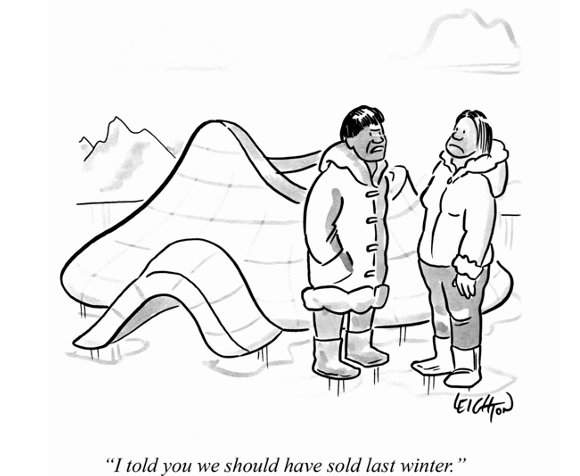
Using the message of the cartoon as a starting point, write an e-mail in which you comment on major effects of climate change and the ways in which individuals can fight it.
from: https://www.cartoonstock.com/cartoon?searchID=WJ500267
Text I (nicht-literarisch)
Frustration, defiance in village to be abandoned to the sea
Sylvia Hui, “Frustration, defiance in village to be abandoned to the sea”, Associated Press, 11.11.2021
Weiter lernen mit SchulLV Plus!
monatlich kündbarSchulLV Plus-Vorteile im ÜberblickDu hast bereits einen Account?dilemma: inhabitants know they will have to leave Fairbourne but don’t want to
-
beautiful, good place to live; close community
-
but: due to its location, soon to be impacted by climate change
-
in 2014 authorities decided to stop protecting Fairbourne against rising sea levels by 2054 due to high costs
reactions of the inhabitants:
-
shock and anger over authorities’ decision to abandon village, doubt that exact date can be predicted when life in Fairbourne no longer possible
-
psychological problems due to unanswered questions regarding future
-
optimism:
-
continue lives regardless of looming threat; want to stay put as long as possible
-
actively provide for future
-
the writer’s attitude: Sylvia Hui sympathises with the inhabitants of Fairbourne
use of language:
-
describes life in Fairbourne and surroundings in very positive terms: choice of words, e. g. “the peaceful, slow pace of small village life” (ll. 2-3), “nestled between the rugged mountains and the Irish Sea” (ll. 3-4) → painting image of unspoiled village and attractive lifestyle
-
criticizes the decision to no longer protect this idyllic place: contrast, e. g. “home for life” (l. 2) – “abandon the village to the encroaching sea” (l. 14) → highlighting the human tragedy
-
lays out dramatic effect of decision on residents:
-
metaphor, e. g. “Overnight, house prices in Fairbourne nosedived.” (l. 15) → illustrating devastating economic consequences
-
choice of quotes from newspaper articles, e. g. Fairbourne residents as “climate refugees” (l. 16); “decommissioned” (l. 17) → showing scale of problem and highlight contrast between official approach and devastating consequences
-
-
provides detailed description of village: contrast, e. g. “retirees” (l. 22) – “young families raising a next generation” (ll. 22-23); enumeration, e. g. “And although the village center only consists of a grocer’s, a fish and chip shop and a couple of restaurants, residents say the pebbly beach and a small steam train draw bustling crowds in the summer” (ll. 23-25) → showing its vibrant community
-
questions decision to no longer protect Fairbourne: metaphor, e. g. “ultimately boil down to cost” (l. 35) → to show it is in essence a financial decision
-
reflects on Fairbourne’s future: use of questions, e. g. “When and how will evacuation take place? Will they be compensated, and if so how much should it be?” (ll. 38-39) → highlighting scope of problem
-
ends article with powerful quote by resident, “What you have here is a human catastrophe, albeit on a small scale” (l. 54) → underlining tremendous consequences of decision on inhabitants
explanation of the quotation:
resident of village that will disappear due to climate change seems resigned to his fate, but is determined to go on with his ‘normal’ life for as long as he can
different attitudes towards climate change:
-
wide range of attitudes, individual positions not always clearly delineated
-
climate denial/scepticism:
-
claim climate change is hoax or humans not responsible for it
-
some politicians (e. g. some members of Republican Party in US) use this attitude to garner votes; refuse to support international agreements (e. g. Paris climate agreement) or to pass legislation that might harm industry (e. g. CO2 certificates, ban on fossil fuels)
-
-
climate fatalism/indifference:
-
indifferent to changes and possible outcomes
-
passive due to feeling of powerlessness; not aware that even small steps might help
-
-
climate concern
-
aware that climate change exists and potentially harmful (e. g. extreme weather conditions leading to destruction of property, death, hunger, migration)
-
yet still only do little to fight climate change: focus on own well-being, unwilling to change habits (e. g. means of transport, food, use of fossil fuels)
-
-
climate action/activism:
-
keenly aware of climate change, possible dangerous outcomes and fact that world needs to act fast
-
actively work to address problem on individual level (alternative modes of transport, renewable energy, less/no meat, less/no plastic etc.) and/or take political action or support certain organizations (e. g. Fridays for Future, WWF, Greenpeace)
-
some take more drastic steps: organize protests (e. g. Greta Thunberg), even risk own physical well-being and clashes with authorities/the law (e. g. Last Generation); problem that extreme forms of activism (e. g. people gluing themselves to roads or famous paintings) might turn public opinion against them
→ if world wants to keep climate change at tolerable level, people have to change their attitudes, especially in rich countries which haven’t yet experienced its most dramatic consequences; extreme activism might not be right way, but decisive action on personal and political level urgently required
-
message of the cartoon:
climate change will have a negative effect on property values in certain places while also greatly affecting people’s way of life
major effects of climate change:
-
hotter temperatures lead to
-
melting of polar ice caps and glaciers à rising sea levels à flooding of low-lying areas → migration
-
more severe weather events, e. g. storms and heavy rainfall → destruction of houses and infrastructure, negative effect on economy; endangering people’s lives
-
more wildfires → destruction of vast areas of land and maybe even people’s homes, habitat loss; putting people’s lives at risk
-
more droughts → fewer crops → higher food prices; hunger / malnutrition / starvation (→ migration); desertification
-
loss of certain species and spread of species to other parts of world → health risks linked to spread of disease; changing eco-systems
-
-
increased poverty in the long run à inequality, migration
→ devastating consequences already apparent, sooner or later everyone will be affected
ways in which individuals can fight climate change:
-
everyone can do their bit, e. g. by reducing waste, recycling, using public transport or going by bike, avoiding unnecessary flights, buying locally produced organic products, saving energy
-
lobbying (local) governments: stricter environmental legislation, international cooperation, help for poorer countries
→ urgent call to action