
Thema 1
Wähle aus dem Prüfungsteil 2 ein Thema zur Bearbeitung aus.
Der Prüfungsteil 3 ist verpflichtend zu bearbeiten.
Maiden Speech for 118th Congress
Outline what Alex Padilla says about the immigration experience of his family and of other immigrants in the U.S. today.
Analyze how Padilla conveys his view on the American Dream. Focus on communicative strategies and use of language.
Choose one of the following tasks:
“But that Dream has never been about passive participation. It’s made possible by those who work for it and by those willing to defend it and expand it.” (ll. 17–19).
Taking the quotation as a starting point, assess to what extent the American Dream is still attainable in contemporary U.S. society.
or
As a participant at an international summer school course on immigration at a U.S. university, you have been given the assignment to write an entry for the participants’ blog based on the cartoon below, which had recently been published in that blog.
Taking the message of the cartoon as a starting point, write the blog entry, commenting on the appeal of the U.S. as a destination for immigrants today.
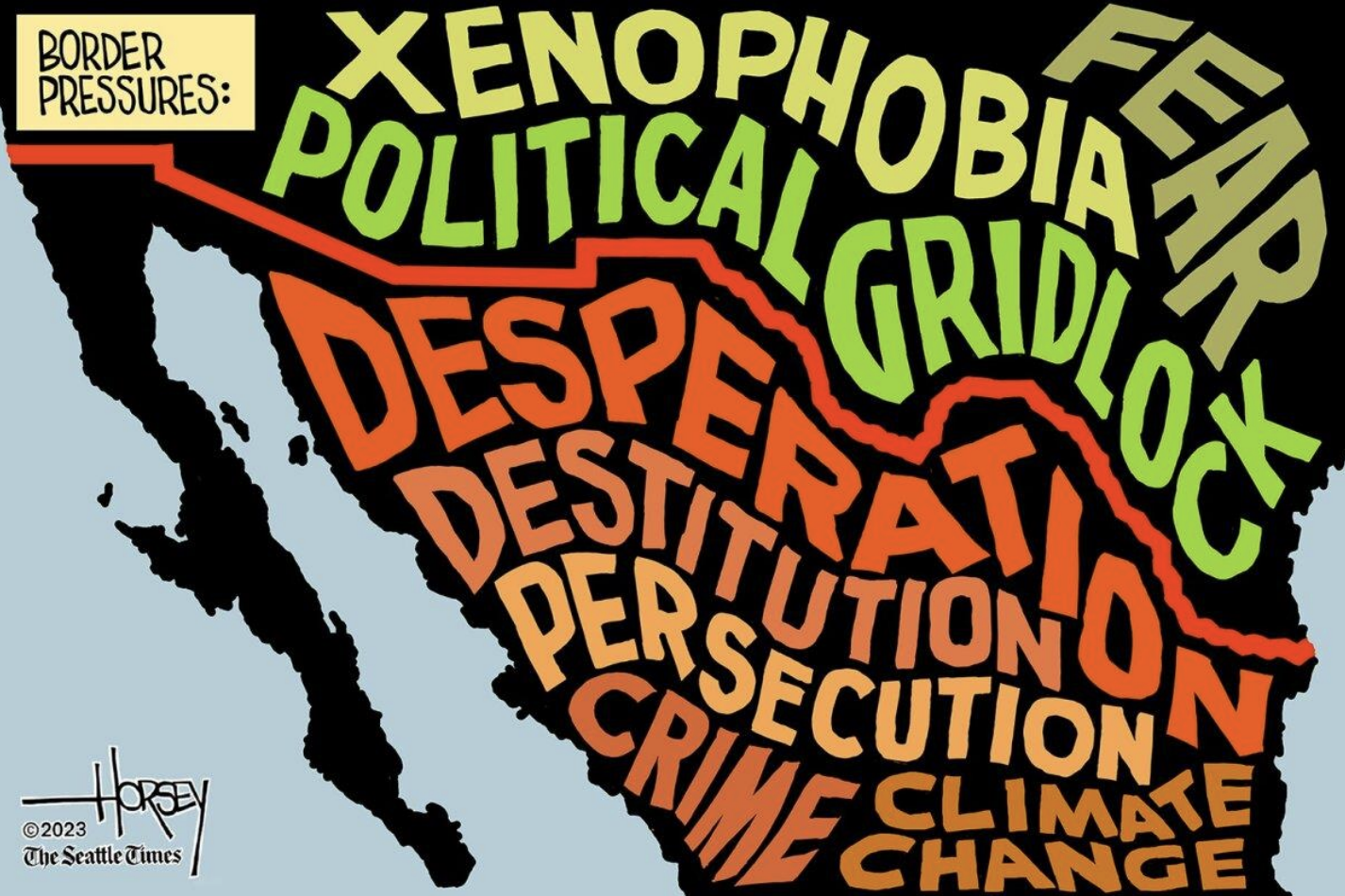
David Horsey: Border Pressures. (The Seattle Times, 2023) (accessed: 20 January 2024)
Weiter lernen mit SchulLV Plus!
monatlich kündbarSchulLV Plus-Vorteile im ÜberblickDu hast bereits einen Account?Alex Padilla’s Maiden Speech for 118th Congress
795 words
Padilla, A. (2023). Padilla Outlines Priorities to Keep the American Dream Alive in Maiden Speech for 118th Congress. 15 February 2023.
Weiter lernen mit SchulLV Plus!
monatlich kündbarSchulLV Plus-Vorteile im ÜberblickDu hast bereits einen Account?Task 1
-
In his maiden speech for the 118th Congress, Alex Padilla presents his family’s immigration story as a powerful example of both hardship and upward mobility in the United States. At the same time, he contrasts their experience with the difficult and often precarious situation of many immigrants living in the U.S. today.
-
Padilla explains that his parents were poor immigrants from Mexico who came to California in search of a better life. His father worked for forty years as a short-order cook and his mother cleaned houses while raising three children (ll. 5–6). He describes how they lived in a neglected, crime-ridden neighborhood, mentioning “buckled sidewalks” and “drug dealers” (l. 9). The family often lived “paycheck to paycheck” (ll. 10–11), which illustrates their financial insecurity.
-
Despite these hardships, his parents showed hard work (l. 15), perseverance, and made significant sacrifices. Padilla refers to their physical exhaustion, such as “tired eyes and a sore back” (l. 21), underlining the daily struggle of immigrant families. He also mentions that his family relied on financial aid so that he could attend college.
-
Ultimately, Padilla presents his own political career as proof that his family realized the American Dream. As the “first Latino” senator from California (l. 1), he describes himself as the “first-generation son of a short order cook and a housekeeper … now in the United States Senate” (ll. 16–17). His biography therefore becomes evidence of social mobility and opportunity in the U.S.
-
However, Padilla contrasts this success story with the present reality for many immigrants. He highlights family separation, the constant threat of deportation, and an insecure legal status. Many immigrants lack a pathway to citizenship and face “crippling visa backlogs” (ll. 41–42). Furthermore, he criticizes that immigrants are often denied recognition as an indispensable and reliable workforce.
-
In conclusion, Padilla presents his family’s story as a narrative of perseverance and achievement, while emphasizing that for many immigrants today, structural barriers and restrictive policies make the realization of the American Dream far more difficult.
Task 2
-
In his maiden speech, Alex Padilla presents the American Dream as both attainable and threatened. He conveys his view through a combination of personal narrative, emotional language, rhetorical devices, and political appeals.
-
First, Padilla establishes ethos by portraying himself as living proof of the American Dream. By calling himself the “first Latino” senator (l. 1) and the “first-generation son of a short order cook and a housekeeper … now in the United States Senate” (ll. 16–17), he creates a strong symbolic contrast between humble beginnings and political success. His statement that his family’s story reflects what “hardworking families have experienced” (ll. 2–3) universalizes his biography and connects it to a broader immigrant experience.
-
He strengthens this effect through imagery and emotionally charged vocabulary. Expressions such as “live paycheck to paycheck” (ll. 10–11) and “tired eyes and a sore back” (l. 21) evoke vivid pictures of hardship. Negative connotations like “buckled sidewalks” and “drug dealers” (l. 9) highlight social disadvantage. These descriptions appeal to the audience’s pathos and generate empathy.
-
Padilla also uses rhetorical devices to reinforce his message. The anaphora “I remember … I remember …” (ll. 8–13) emphasizes authenticity and emotional involvement. The repetition in “They are the American story. They are the American Dream.” (l. 53) elevates immigrants rhetorically and equates them with the nation’s identity. The enumeration “get up … before the sun rises, put on a white apron, and push through tired eyes” (ll. 20–21) stresses the routine and discipline behind success. Furthermore, the alliteration in “never … passive participation” (ll. 17–18) underlines his central thesis that the American Dream requires active engagement.
-
Beyond the personal level, Padilla appeals to shared national values. By referring to the Statue of Liberty’s “huddled masses” (l. 46), he uses a historical allusion to connect immigration with foundational American ideals. His reference to the Civil Rights Movement (cf. ll. 47–49) evokes a tradition of expanding rights and opportunity, creating a sense of moral obligation.
-
In addition, Padilla directly addresses his colleagues, using inclusive pronouns (“Colleagues, we have to be focused … make sure the American Dream is alive”, ll. 28–29). His rhetorical questions (“Who’s willing …? And what are we …?”, ll. 29–30) invite participation and responsibility. Emotive expressions such as “survival of the American Dream” (l. 35) dramatize the urgency of the issue.
-
Finally, he criticizes current shortcomings, mentioning “reform our outdated immigration system … creating a pathway to citizenship” (ll. 37–38) and condemning “crippling visa backlogs” that “keep families apart” and “deny … workforce” (ll. 41–42). By combining critique with concrete policy proposals, he moves from narration to political action.
-
Overall, Padilla presents the American Dream as a living but vulnerable ideal. Through ethos, pathos, repetition, imagery, historical references, and direct appeals, he argues that the Dream must be actively protected, defended, and expanded.
Task 3.1
-
In his speech, Padilla claims that the American Dream requires active participation, hard work, and the willingness to defend and expand opportunities (ll. 17–19). This quotation suggests that success is neither automatic nor guaranteed but depends on individual effort and collective responsibility. Whether the American Dream is still attainable today is a complex question that requires a balanced evaluation.
-
On the one hand, the American Dream remains attainable in several respects. The U.S. Constitution guarantees civil and human rights and provides opportunities for democratic participation. Educational institutions, scholarships, and integration programs help individuals improve their social mobility. Affirmative action policies and community support systems aim to support minorities.
-
Moreover, the U.S. still offers economic opportunities in technology, science, entrepreneurship, and creative industries. Many immigrants and first-generation Americans have become successful entrepreneurs, scientists, artists, and politicians—Padilla himself being a prominent example. The belief in hard work, sacrifice, and personal responsibility continues to motivate people to pursue ambitious goals.
-
On the other hand, structural inequalities limit equal access to success. Education alone does not automatically guarantee upward mobility. The widening gap between rich and poor, rising living costs, and limited access to affordable healthcare create significant barriers. Immigrants, especially undocumented ones, often face legal insecurity, exploitation, and fear of deportation.
-
Minorities are still underrepresented in high political positions, and political achievements such as voting rights or affirmative action have been contested in recent years. In addition, social polarization and xenophobia have made parts of society less welcoming toward immigrants.
-
Therefore, the American Dream is neither fully obsolete nor universally accessible. It remains attainable, but not equally for everyone. Achieving it often requires extraordinary effort, resilience, and structural support. As Padilla argues, the Dream must be defended and expanded politically to ensure equal opportunities. Without reforms addressing inequality, immigration policy, and access to education and employment, the Dream risks becoming increasingly difficult to realize for large parts of the population.
-
In conclusion, the American Dream is still possible in contemporary U.S. society, but its attainability depends heavily on social background, legal status, and political conditions. It remains a powerful ideal, yet one that demands both personal effort and systemic reform.
Task 3.2
Still the Land of Opportunity? Immigration and the Appeal of the U.S. Today
When I first saw the cartoon “Border Pressures” by David Horsey, I was struck by how clearly it visualizes the tensions surrounding immigration at the U.S.-Mexican border. On the Mexican side, words such as desperation, destitution, persecution, crime, and climate change dominate the image. On the U.S. side, however, terms like xenophobia, political gridlock, and fear appear. The cartoon suggests that pressures exist on both sides of the border — but it also implies that, despite these tensions, the United States may still represent fewer existential threats than many immigrants’ home countries.
So the question is: How attractive is the U.S. today as a destination for immigrants?
Push and Pull: Why People Still Come
For many migrants from South and Central America, Mexico and beyond, migration is not simply a choice — it is often a necessity. Political instability, violence, economic collapse, persecution, and the effects of climate change function as strong push factors. Compared to these conditions, the U.S. offers relative political stability, economic opportunity, and stronger legal protections.
The United States continues to embody the idea of the American Dream — the promise that hard work can lead to a better life. The country still provides employment opportunities for both skilled and unskilled workers. Many sectors, from agriculture and construction to technology and healthcare, rely heavily on immigrant labor. In addition, the Green Card system and student visa programs create legal pathways to study and work.
Another factor contributing to the U.S.’s appeal is its diversity. In many regions, immigrants can find established communities of people who share their language and cultural background. Spanish, for example, is widely spoken in many parts of the country, which can ease integration. Moreover, the U.S. remains a global leader in fields such as technology, science, media, and popular culture, reinforcing its image as a land of innovation and opportunity.
For many people around the world, especially those facing insecurity at home, the U.S. still appears more attractive than their country of origin.
A Fading Promise?
However, the cartoon also highlights a growing counterforce: xenophobia, political gridlock, and fear. In recent years, immigration has become one of the most polarizing political issues in the United States. Rising numbers of undocumented immigrants have intensified public debate, and parts of the population have become less welcoming.
More restrictive immigration policies under recent administrations have made it increasingly difficult to enter the country legally. Lengthy visa backlogs, stricter asylum rules, and complex bureaucratic procedures create uncertainty and frustration. For undocumented immigrants, the risk of deportation remains a constant threat.
Furthermore, social security benefits, such as health insurance or unemployment support, are often not accessible to undocumented immigrants. This can result in precarious working and living conditions. Exploitation and unfair labor practices remain a serious issue in certain sectors. In addition, political hostility has sometimes led to racial profiling and discrimination.
These developments raise doubts about whether the American Dream is equally attainable for everyone.
Between Hope and Reality
The cartoon’s message is therefore ambivalent. It acknowledges that “border pressures” exist on both sides — but it subtly suggests that, despite fear and political division, the U.S. still represents hope compared to the desperation many migrants are fleeing.
In my view, the United States remains attractive — but not unconditionally. It continues to offer economic opportunity, political stability, and civil rights that many countries cannot guarantee. At the same time, increasing polarization and restrictive policies weaken its image as a welcoming nation.
Whether the U.S. remains the “land of opportunity” will depend on its willingness to address immigration reform, reduce political gridlock, and reaffirm its commitment to equality and inclusion.
For now, the American Dream has not disappeared — but it is under pressure.