
Thema 2
Lessons in Chemistry
Sum up the information on Mr. Pine and his daughter.
Analyze how Elizabeth Zott is presented. Focus on narrative techniques and use of language.
Choose one of the following tasks:
Later in the novel, Elizabeth Zott, as a TV personality, addresses the mainly female audience of her cooking show as follows: “Whenever you start doubting yourself […], make this pledge. No more holding yourself back, no more subscribing to others’ opinions of what you can and cannot achieve.” (Lessons in Chemistry, p. 360). Taking Elizabeth Zott’s situation in the 1960s as a starting point, discuss whether her advice is still useful in times of increasing gender equality.
or
With a group of international students, you are planning a cartoon exhibition at your university on Parent-Child Relationships – On the Road to Independence. A member of your group has suggested including the cartoon below in the exhibition. Write an email to the group, commenting on the choice of the cartoon.
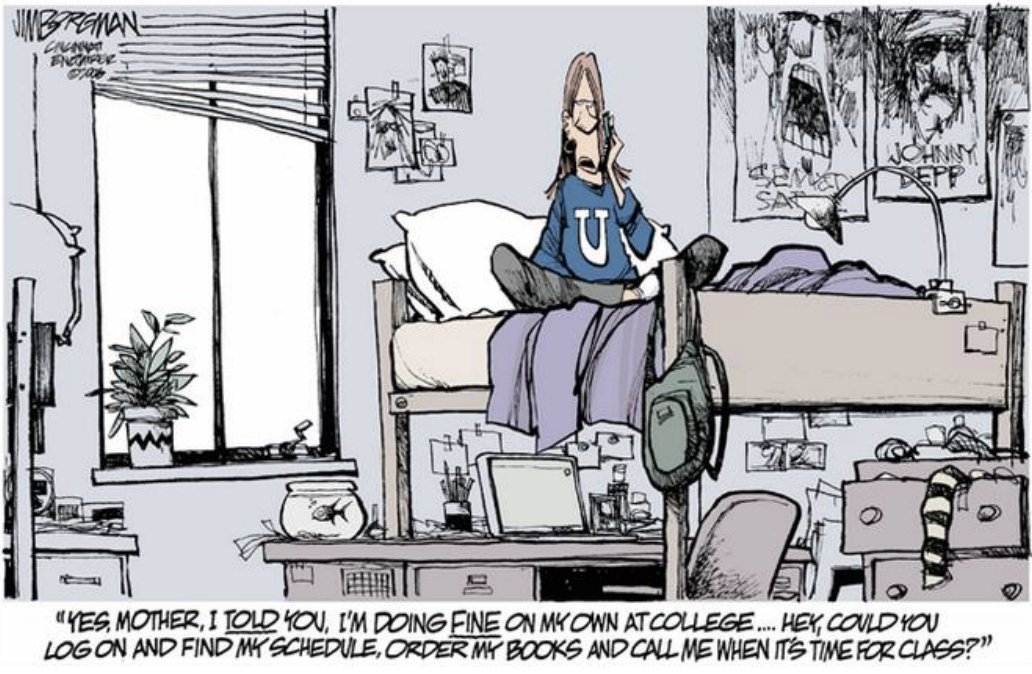
Jim Borgman: Yes, mother, I told you ... (Cincinnati Enquirer, 20 August 2006)
Weiter lernen mit SchulLV Plus!
monatlich kündbarSchulLV Plus-Vorteile im ÜberblickDu hast bereits einen Account?Lessons in Chemistry
by Bonnie Garmus
The novel is set in the US in the 1960s. Elizabeth Zott enters Walter Pine’s office at the local
TV station while he is desperately trying to come up with a new idea for the afternoon program.
She wants to talk with him about his daughter Amanda.
795 words
Garmus, B. (2022). Lessons in Chemistry. New York: Doubleday. pp. 3–6.
Weiter lernen mit SchulLV Plus!
monatlich kündbarSchulLV Plus-Vorteile im ÜberblickDu hast bereits einen Account?Task 1
-
In the excerpt from Lessons in Chemistry, the focus lies on Walter Pine, a television producer, and his daughter Amanda, whose behavior at school causes conflict.
-
Walter Pine works at a TV station as a producer of soap operas and daytime television shows. He is portrayed as a man in a leading media position who is used to authority and influence. Before Elizabeth Zott appears in his office, he has not returned her phone calls, mainly because he does not know her and does not consider her important. When she enters his office wearing a white lab coat, he is deeply impressed by her appearance. The omniscient narrator describes her as a woman who stood “resplendent … white lab coat … aura of holy light” (ll. 24–25). Pine initially assumes she has come for a casting, revealing his superficial and television-centered perspective.
-
Instead of expecting confrontation, he eventually offers her a position as a TV host in a new show, which later becomes her cooking program. His reaction — he “could only stare” (l. 29), “stammered” (l. 32), and appeared “suddenly embarrassed” (l. 51) — underlines that he is unsettled by Elizabeth’s confidence.
-
Amanda, Walter Pine’s daughter, is an elementary school girl. She has the habit of eating more than is good for her and repeatedly eats her classmate Madeline’s lunch, which is portrayed as something special and carefully prepared. Amanda is described as the only one in her school who accepts and befriends Madeline, which creates a morally ambiguous situation: she shows social openness but simultaneously exploits Madeline’s kindness.
-
The conflict arises because Amanda has been eating Madeline’s lunch for months (ll. 27–28). This behavior triggers Elizabeth Zott’s confrontation with Mr. Pine.
-
Overall, Walter Pine is presented as a powerful but somewhat superficial media executive, while Amanda appears as a child who combines friendliness with selfish behavior, leading to the central conflict of the scene.
Task 2
In the excerpt, Elizabeth Zott is portrayed as a scientist, a caring mother, and a self-confident woman. The author uses a combination of scenic presentation, omniscient narration, direct speech, and stylistic devices to shape her character.
1. Elizabeth as a scientist
-
Elizabeth is introduced visually through scenic presentation, wearing a “white lab coat” (l. 25), immediately associating her with scientific authority. In direct speech, she clearly states, “I’m a chemist” (l. 43), reinforcing her professional identity. The omniscient narrator further describes her as “a research chemist” (l. 63), establishing credibility and rationality.
-
Her language reflects a scientific mindset. Expressions such as “According to her calculations … scientifically inconceivable” (ll. 12–14) and the use of the word “catalyst” (l. 55) demonstrate a science-related vocabulary. Even when addressing personal issues, she approaches them analytically. The narrator clarifies: “Elizabeth wasn’t an alarmist … scientist … sought a sensible explanation” (ll. 14–16), presenting her as rational rather than emotional.
-
Irony appears in her reference to her workplace: “Hastings Research Institute? Where Groundbreaking Research Breaks Ground?” (ll. 45–46). The wordplay suggests pride in her profession but also subtle criticism of institutional emptiness.
2. Elizabeth as a caring mother
-
Elizabeth’s maternal side is presented through focalization and panoramic narration. The passage “The story was simple … Elizabeth noticed … began to wonder … knew she’d found it” (ll. 1–17) illustrates her attentive observation and rational reflection. She investigates the situation methodically instead of reacting impulsively.
-
Her care is further emphasized in the detailed enumeration of Madeline’s lunch: “thick slice of leftover lasagna, a side helping … a red plaid thermos full of ice-cold milk” (ll. 4–6). The precision of this description shows her effort and scientific knowledge of nutrition.
-
A contrast is created with “While … other children gummed their peanut butter and jelly sandwiches” (l. 3), highlighting Elizabeth’s higher standards and ambition as a mother.
-
Furthermore, she is willing to sacrifice professionally: “she took the job … it paid more and she had a child to support” (ll. 63–64). The matter-of-fact tone underlines that she prioritizes her daughter’s wellbeing over her own preferences.
3. Elizabeth as a self-confident woman
The confrontation scene (ll. 18–58) presents Elizabeth as determined and fearless. Through direct speech, she confronts Pine clearly and assertively:
-
“My name … I’m here to tell you that your … is eating my daughter’s lunch.” (ll. 20–23)
-
“Your daughter … eats my daughter’s lunch … for months.” (ll. 27–28)
-
“pretends … absolutely reprehensible.” (ll. 30–31)
Her choice of words shows moral clarity and refusal to tolerate injustice.
-
Indirect characterization further strengthens this impression. She is described as “sweeping … past a secretary” (l. 18), suggesting determination. Her “eyes growing narrow” (l. 56–57) indicate controlled anger. She is not intimidated by Pine’s authority.
-
The omniscient narrator presents Pine’s perspective to enhance her impact: he “could only stare” (l. 29), “stammered” (l. 32), was “suddenly embarrassed” (l. 51), and is described as “literally stunned” (l. 35). The repetition — “He continued to stare. She was stunning. He was literally stunned.” (l. 35) — emphasizes her commanding presence.
-
Overall, Elizabeth is depicted as an intelligent, rational, morally upright, and strong woman who confidently challenges male authority and defends her daughter.
Task 3.1
-
Elizabeth Zott’s advice — “No more holding yourself back, no more subscribing to others’ opinions of what you can and cannot achieve.” — is directed primarily at women in the 1960s, encouraging them to overcome prejudice and lack of confidence.
-
In the 1960s, women faced systemic discrimination in academia and professional life. Elizabeth herself is both a scientist and a working mother, forced to fight for recognition in a male-dominated environment.
-
She is not afraid to stand her ground — even against a man in an executive position — and she leaves a strong impression on him. Her advice therefore reflects her lived experience.
-
Today, her message remains relevant. Although gender equality has progressed significantly — including political empowerment, improved educational access, and broader social acceptance — traditional gender roles and expectations still influence career and lifestyle choices. Her advice helps young people recognize how societal expectations may hold them back and encourages them to act confidently. It also emphasizes the need to break structural barriers such as the “glass ceiling” and the gender pay gap.
-
However, one could argue that the advice oversimplifies reality. Individual determination alone is not enough; structural inequalities require political and institutional change. Furthermore, success often depends on support systems such as education, family, and social networks.
-
In conclusion, Elizabeth Zott’s advice remains valuable as a call for self-confidence and agency, but it must be combined with broader structural efforts toward equality.
Task 3.2
Subject: Thoughts on Including the Cartoon in Our Exhibition
Dear everyone,
I’ve been thinking about the suggestion to include the cartoon in our exhibition on Parent-Child Relationships – On the Road to Independence, and I would like to share my thoughts.
The cartoon presents a college student who believes or pretends to have achieved independence in university life, yet still relies heavily on parental support to organize everyday matters. This creates an ironic contrast between the desire for autonomy and continued dependence.
In my view, the cartoon could be a strong choice for the exhibition. It highlights a typical transition phase in young adulthood: students may deny having problems while being away from home, but at the same time expect their parents — often their mother — to remain constantly available. This situation is recognizable and therefore relatable to many visitors.
Moreover, the cartoon encourages self-reflection. Students who are overly dependent on their parents might see their behavior in a critical light and feel motivated to take on more responsibility. The depiction is not overly specific in terms of gender, degree course, or background, which makes it easier for a broad audience to identify with the situation.
However, we should also consider potential criticism. Some might argue that the cartoon relies too much on clichés — for example portraying a relatively untidy student still in bed and unable to manage daily tasks. Many students strive for independence and manage their university lives successfully. In addition, the cartoon might oversimplify the real challenges of adapting to university life.
Overall, I believe the cartoon would fit well into our exhibition because it addresses a timeless and universal issue: the gradual process of becoming independent. If we contextualize it properly, it could spark meaningful discussion.
Best regards, [Your Name]