
Text
Dad’s Flag
1
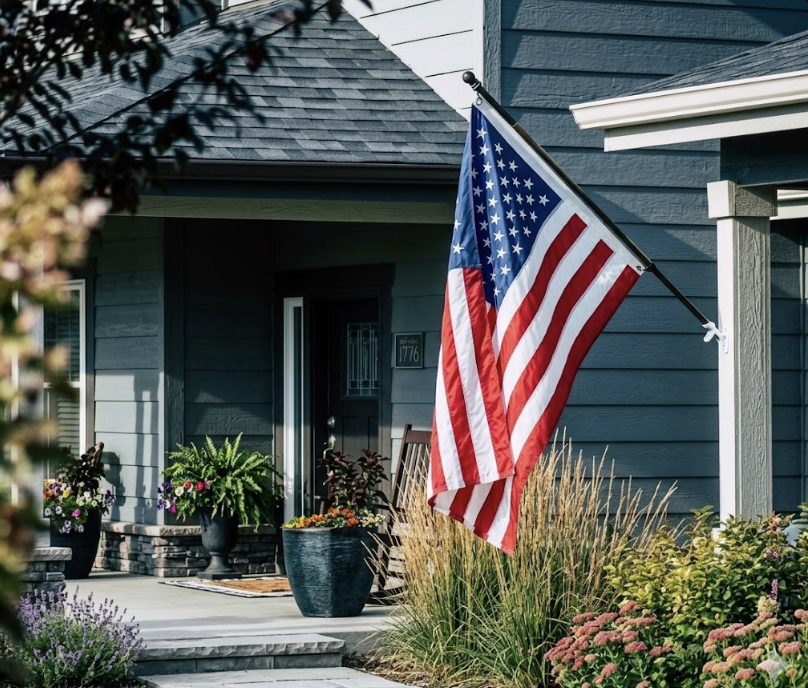
Like many African-Americans, my dad always flew a US flag in
2
our front yard. The blue paint on our house was chipping. The
3
fence or the handrail by the stairs or the front door existed in a
4
constant state of disrepair, but that flag always flew brand new.
5
Our home was by the river that divided our Iowa town. [1] At the
6
edge of our lawn, high on an aluminum pole, flew the flag, which
7
my dad would replace as soon as it showed the slightest tatter.
8
My dad was born into a family of sharecroppers on a white plantation in Greenwood, Missouri, where
9
black people bent over cotton, just as their enslaved ancestors had done not long before. My
10
grandmother, like all the African-Americans in Greenwood, could not vote, use the public library or
11
find work other than sweating in the cotton fields or in white people’s households. So, in the 1940s,
12
she packed up her few belongings and her three small children and fled North. She got off the Illinois
13
Central Railroad in Waterloo, Iowa. [2] Eventually, she got work – cleaning houses.
14
Dad, too, struggled to find recognition in this land. In 1962, at age 17, he signed up for the army. [3]
15
Dad expected that if he served his country, his country might finally treat him as any other American.
16
Before the official end of his service, however, he was released under obscure circumstances. He
17
had to labor in a series of service jobs for the rest of his life. Like all the men and women in my
18
family, he believed in hard work. But like everyone in my African-American family, no matter how
19
hard he worked, he never got ahead. [4] When I was young, that flag outside our home never made
20
sense to me. I didn’t understand Dad’s patriotism.
21
My father always knew that the Black Americans’ contributions to building this rich and powerful
22
nation were undeniable. In an overlooked but vital role, generation after generation, we have helped
23
democracy grow into the true version of itself: a democracy that aims to ensure dignity, freedom and
24
justice for all. The United States is a nation founded on both these ideals and an illusion – to be read
25
in our Declaration of Independence. [5] The founding document of the US was adopted on July 4,
26
1776, by the 13 original British colonies of America and declared them “free and independent
27
states.” The document claims that “all men are created equal”. But did the white men who drafted
28
those words believe them to be true for the hundreds of thousands of women, Native Americans and
29
Black Americans in their midst? [6] Yet although they were denied the freedom and justice promised
30
to all, many Blacks trusted in the American creed.
31
Through centuries of resistance and protest, African-Americans have helped the country live up to
32
the founding ideals of the Declaration of Independence. The Civil Rights Movement culminated on
33
August 28, 1963, in the March on Washington for Jobs and Freedom. [7] The demands included the
34
end of discrimination in education, housing, employment, and more. Protesters and organizers met
35
members of Congress and President John F. Kennedy, while the march ended at the Lincoln
36
Memorial, where Dr. Martin Luther King Jr. delivered his “I Have a Dream” speech. It was a fight for
37
equal rights. And not only for the Black Community – their struggles paved the way for every other
38
rights struggle, including gay rights, immigrant and disability rights. Without the passion and the
39
strenuous and patriotic efforts of Black Americans, US democracy might have developed differently.
40
Now age 43, I am part of the first generation of Black Americans in the history of the US to be born
41
into a society in which we have full rights of citizenship. [8] We were once told that we could never
42
be American. But it was due to our oppression that we became the most American of all. My father
43
knew exactly what he was doing when he raised that flag.
Adapted from nytimes.com, loc.gov, thenational.academy.