
Aufgabe 1.1
TASKS
Outline what Julia Lee says about the contents of her essays and the feedback from her teacher.
Analyze how Julia Lee presents her feelings as a teenager and as an adult looking back at her younger self. Focus on narrative techniques and use of language.
Choose one of the following tasks:
“Why did the white girls in my class enjoy so much privilege? Why did no one want to talk about it?” (ll. 52-53)
Discuss whether Julia Lee’s perception of white privilege reflects the reality of U.S. society today.
OR
You are participating in an international youth program on education in the U.S. organized by the U.S. embassy in Berlin and have been given the cartoon as a writing prompt.
Taking the cartoon as a starting point, write an entry for the blog of the program, assessing to what extent schools can contribute to bridging divisions in U.S. society.
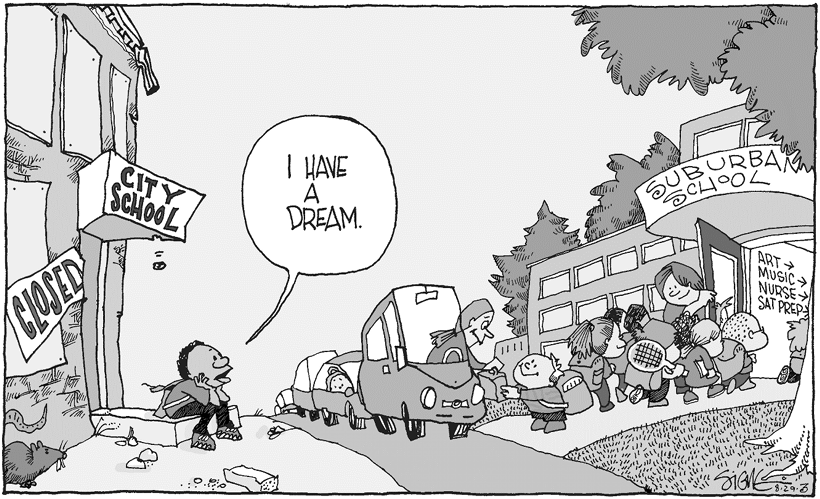
Wilkinson, Signe. “I have a dream.” Signetoons.com. 29 August, 2013.
Accessed on 26 April, 2024 from https://signetoons.com/education.
SAT prep – preparation for a standardized test taken in high school as the basis for college admissions
Text: Excerpt from the novel
Biting the Hand: Growing Up Asian in Black and White America
By Julia Lee
In the following excerpt from her memoir, Korean American author Julia Lee recounts her experiences as a teenager in the 1990s.
1 kimchi – spicy vegetable dish typical of Korean cuisine
2 Ivy League school – one of the most prestigious universities in the U.S.
3 legacy (student) – a student with a close family member who previously attended the same college
4 screed – very long and extremely critical text
(799 words)
Lee, Julia. Biting the Hand: Growing Up Asian in Black and White America. New York: Henry Holt and Company, 2023, 10-13.
Weiter lernen mit SchulLV Plus!
monatlich kündbarSchulLV Plus-Vorteile im ÜberblickDu hast bereits einen Account?Please Note: The solutions presented here are just one possible way to approach the task. There are often multiple valid methods and perspectives, and alternative approaches may be equally effective.
In the excerpt from the novel Biting the Hand: Growing Up Asian in Black and White America, published in 2023, Korean American author Julia Lee reflects on two autobiographical essays she wrote in eighth grade and the different reactions of her teacher, Mrs. Church.
Both essays were written as part of an English class project on the topic of “coming of age”. In her first essay, Lee describes her experiences as a Korean American teenager who feels torn between Korean and American culture. She writes about constant arguments with her mother, her rejection of Korean values and stereotypes, and her wish to appear “un-Korean”. In order to emphasize this, she even falsely claims that she dislikes kimchi, although she actually loves it. Furthermore, she explains that she was not good at maths and therefore did not fit the stereotypical image of Asian Americans.
Mrs. Church reacted very positively to this essay. She gave Lee an A and even wanted to show the text to the head of school because she believed it provided important insight into the assimilation struggles of young Asian American girls. Lee was proud of this praise and enjoyed the teacher’s approval.
Encouraged by this success, Lee wrote a second essay in which she criticized the race and class hierarchy at her school. She argued that the popular students were usually white, wealthy and blond and accused them of excluding students of colour and students from low-income families. Moreover, she complained that these social injustices were ignored by the school community.
In contrast to the first essay, the teacher’s feedback on the second text was rather negative. Although Lee still received a B, she considered it a punishment. Mrs. Church criticized the essay for being too emotional, poorly argued and unconvincing. Later, Lee reflects that the real reason for this reaction may have been that her anger was now directed at white privilege and white supremacy instead of at Korean culture and stereotypes.
In the excerpt, Julia Lee presents both her feelings as a teenager and her reflections as an adult looking back at her younger self. By using a first-person narrator, emotional language and different narrative techniques, she shows her inner conflict, her desire for acceptance and her later, more mature understanding of her experiences.
As a teenager, Lee feels torn between Korean and American culture. The first-person narration makes her emotions appear direct and personal. She openly describes how she “felt torn between [her] parents’ culture and American (…) culture” (ll. 11-12). The negative connotation of the verb “torn” emphasizes her inner conflict and confusion about her identity. Furthermore, repetition underlines how strongly she wanted to distance herself from Korean stereotypes. She admits that she lied about disliking kimchi “to emphasize just how un-Korean” she was and later repeats the phrase “to emphasize” when describing her attempt to appear “unstereotypically Asian” (ll. 13-17). This repetition highlights the pressure she felt to fit into white American culture.
In addition, Lee presents herself as a teenager who desperately wanted appreciation and recognition. This becomes clear through figurative language. For example, she compares Mrs. Church’s praise to “a shot of adrenaline” (ll. 26-27). The simile shows how exciting and empowering the teacher’s approval felt to her. Similarly, the metaphor “ravenous for teacher approval” (l. 40) suggests an almost desperate hunger for acceptance. These stylistic devices emphasize how important external validation was for her self-confidence.
At the same time, Lee portrays herself as proud and increasingly self-confident about her writing skills. Italics are used for emphasis when she states: “I was a good writer, too. I had important things to say, too” (ll. 24-25). This stresses her wish to be recognized like the admired white student at her school. Moreover, the author uses adjectives connected with strength and confidence, such as “cocky” (l. 26), “powerful” and “brave” (l. 27), and “Emboldened” (l. 29). These words show that Lee felt she had finally found her voice and the courage to criticize injustice. She also describes the second essay as “an easy piece to write because it felt so true” (l. 34), which underlines her conviction that her criticism was justified.
However, Lee also expresses deep frustration and insecurity when her second essay receives criticism. The negative connotation in the sentence “I was devastated” (l. 37) demonstrates how painful the teacher’s reaction was for her. In addition, the repeated use of the word “rage” (ll. 9, 41, 49, 52) stresses the intensity of her emotions throughout the text. Rhetorical questions and self-reflection further reveal her disappointment and self-doubt. When she asks, “How could anyone not see what I was describing?” (ll. 34-35), she expresses her frustration that others ignored obvious injustice. Later, thoughts such as “Maybe my writing was crappy, after all” (ll. 41-42) show how quickly criticism destroyed her confidence.
As an adult looking back, Lee presents herself in a more reflective and differentiated way. She repeatedly questions the reliability of her own memories. Through the use of modal verbs and cautious language, she distances herself from her teenage perspective. For example, she writes: “I have no way of knowing if Mrs. Church was right” (l. 44) and explains that “memory can play tricks” (l. 46). This demonstrates maturity and self-awareness. The anaphora in “Maybe … Maybe …” (l. 47) also emphasizes uncertainty and shows that she now considers different interpretations of the situation.
Furthermore, Lee critically reflects on her own behavior as a student. The phrase “In retrospect, it makes me cringe” (ll. 14-15) has a strong negative connotation and reveals embarrassment about her rejection of Korean culture. Likewise, the comment in parentheses “(which I thought was a punitive grade)” (ll. 37-38) shows that she now recognizes how emotional and subjective her younger reaction may have been.
Nevertheless, the adult narrator still believes that her teenage anger was justified. The comparative structure “the more I think about it, the more I’m convinced” (ll. 48-49) emphasizes her growing certainty that the teacher was uncomfortable because the essay criticized “white supremacy” (l. 52). Thus, Lee’s adult perspective combines self-criticism with the conviction that the racial and social injustices she described were real.
Overall, Julia Lee uses emotional language, repetition, figurative language and reflective narration to contrast the insecurity and anger of her teenage self with the more balanced but still critical perspective of her adult self.
In the quotation, Julia Lee questions why white students at her school seemed to enjoy so many advantages and why racial inequality was ignored by others. As a teenager, she feels frustrated because the school community appears to accept white privilege as normal while students of colour are marginalized. Her questions express anger about social injustice and the silence surrounding racism. Even today, her perception partly reflects the reality of U.S. society, although important progress has also been made.
On the one hand, there are still many examples showing that white privilege continues to exist in the United States. White Americans still make up a large part of the country’s political, economic and social elite. Although opportunities for minorities have improved, invisible barriers remain in areas such as education and employment. In recent years, affirmative action programs at universities have been reduced or abolished, which many critics believe makes it more difficult for students from minority backgrounds to access prestigious institutions.
In addition, discrimination against People of Color can still be found in everyday life and in institutions. Studies show that Black Americans and other minorities are more likely to experience disadvantages in housing, healthcare and employment. Racial profiling by the police and harsher sentencing in the justice system are also frequently discussed problems. Therefore, many people would agree with Lee’s criticism that racial inequality is often deeply rooted in American society.
Another aspect is the representation of minorities in the media. Even today, People of Color are sometimes associated with negative stereotypes or underrepresented in powerful and positive roles. Furthermore, hostility towards immigrants has increased in some political debates. Strict immigration policies and deportations have created fear and insecurity in many immigrant communities. This development supports Lee’s view that white privilege and unequal treatment are still important issues in the United States.
On the other hand, it would be unfair to claim that nothing has changed since Julia Lee’s school years. American society has become much more diverse in recent decades. People from different ethnic backgrounds are now more visible in politics, sports, entertainment and higher education. For example, successful athletes, musicians and actors from minority groups are widely admired and celebrated. Diversity is often seen as a cultural enrichment rather than a problem.
Moreover, social movements such as Black Lives Matter have increased public awareness of racism and discrimination. These movements have encouraged discussions about police violence, inequality and representation. As a result, some reforms and policy changes have been introduced. In addition, the history of the Civil Rights Movement already led to important progress, such as better legal protection against discrimination and improved access to education for minorities.
In conclusion, Julia Lee’s perception of white privilege still reflects parts of U.S. society today because racial inequality and discrimination continue to exist in many areas of life. However, American society has also changed significantly through greater diversity, social activism and political progress. Therefore, her criticism remains relevant, even though the situation today is more complex and more diverse than it was during her teenage years.
Can Schools Help Bridge Divisions in U.S. Society?
The cartoon shows two very different schools in the United States. On the left side, there is a “City School” that is closed and appears neglected. A Black child is sitting alone in front of the building and saying, “I have a dream.” This is a clear reference to Martin Luther King Jr. and his famous speech about equality and equal opportunities. On the right side, there is a modern and attractive “Suburban School” where smiling students are entering the building. Signs advertising activities such as art, music and SAT preparation suggest that this school is well-funded and offers many opportunities.
The cartoon highlights the racial and socio-economic divide in American society. It suggests that students from poorer inner-city neighborhoods, who are often People of Color, have fewer educational opportunities than mostly white students from wealthier suburban areas. As a result, the cartoon raises the question of whether schools can really help reduce divisions in U.S. society.
On the one hand, schools can play an important role in bringing people together. Public education gives children and teenagers the chance to gain knowledge, develop skills and improve their future opportunities. Schools can also create a sense of community by promoting diversity, inclusion and teamwork. In multicultural classrooms, students learn to work with people from different ethnic, social and cultural backgrounds. This can help reduce prejudice and encourage tolerance.
In addition, schools can teach values such as respect, social responsibility and civic engagement. Subjects like history and social studies encourage students to think critically about discrimination, inequality and democracy. Extracurricular activities such as sports teams, music groups or volunteer projects can also strengthen cooperation between students from different backgrounds.
Furthermore, schools can support disadvantaged students directly. Scholarships, financial aid and counseling programs can help students from low-income families access better educational opportunities. Many schools also offer emotional support, tutoring and special learning programs for students who struggle academically or personally. Partnerships with local organizations and businesses can provide internships and career opportunities that help young people succeed later in life.
However, schools alone cannot solve all divisions in American society. One major problem is the unequal funding of schools. In the U.S., schools in wealthy neighborhoods often receive more financial support because they are funded through local taxes. As a result, suburban schools usually have better buildings, more extracurricular activities and newer materials than schools in poorer inner-city areas. Private schools, which often provide excellent education, are usually only accessible to wealthy families. Therefore, inequality in education continues to exist.
Another challenge is political polarization. In recent years, debates about school curricula, book bans and topics such as Critical Race Theory have divided parents, teachers and politicians. Some families even choose homeschooling because they disagree with what schools teach. This shows that schools are often influenced by wider conflicts in society instead of overcoming them.
Finally, schools are only one factor shaping young people’s lives. Social background, living conditions and the influence of social media also contribute to divisions in society. Online platforms often create echo chambers in which people only interact with opinions similar to their own. This can increase polarization and make mutual understanding more difficult.
In conclusion, schools can definitely contribute to bridging divisions in U.S. society by promoting education, inclusion and equal opportunities. They can help young people develop tolerance and social responsibility. However, schools cannot overcome inequality on their own because broader social, economic and political problems continue to shape American society. The cartoon therefore sends an important message: Martin Luther King’s dream of equality has not yet been fully achieved, and education remains both part of the problem and part of the solution.
But what more can schools do to create equal opportunities for all students? And how can society support schools in reducing social and racial divisions?
Share your thoughts and ideas — after all, creating a more equal society is a responsibility we all share.