
Vorschlag B1
Liberating women
Aufgaben
Der vorliegende Vorschlag enthält in Aufgabe 3 alternative Arbeitsanweisungen.
Outline the information on Black women as part of the U.S. job market in the past and in the present. (Material 1)
Analyze how the authors’ attitude towards the situation of Black women in U.S. society is conveyed. Focus on communicative strategies and use of language.
Choose one of the following tasks:
“If Black women were awarded the value they deserve, the entire nation would take an instrumental step forward in realizing its fullest potential.” (Material 1)
Taking the quotation as a starting point, assess to what extent social and economic progress in the U.S. is inextricably linked to the recognition and appreciation of women of color.
or
The Washington Post has published a special issue for International Women’s Day, in which you have come across the photo (Material 2). The newspaper has invited their readers to share their thoughts on feminism today.
Taking the photo as a starting point, write an online article for their website discussing the necessity of feminist protests in today’s Western world.
Material 1
Andrea Waters King and Jennifer Jones Austin: 60 Years After March on Washington, America’s Progress Hinges on Liberating Black Women
(990 Wörter)
1 Cooper refers to women gaining access to freedom, equality and opportunity as well as to social areas where Blacks have historically been excluded or marginalized.
2 associate degree – level of academic qualification just above a high school diploma and below a bachelor’s degree
3 15th and 19th Amendments – The 15th Amendment (1870) to the U.S. Constitution granted male citizens the right to vote regardless of race, ethnicity, or previous slave status; the 19th Amendment (1920) extended the right to vote to women.
Andrea Waters King and Jennifer Jones Austin: 60 Years After March on Washington, America’s Progress Hinges on Liberating Black Women, in: Time, 24.08.2023, URL: https://time.com/6307505/march-on-washington-Black-women-essay/ (abgerufen am 02.02.2024).
Hinweis
Sprachliche Fehler in der Textvorlage wurden entsprechend der geltenden Norm korrigiert.
Material 2
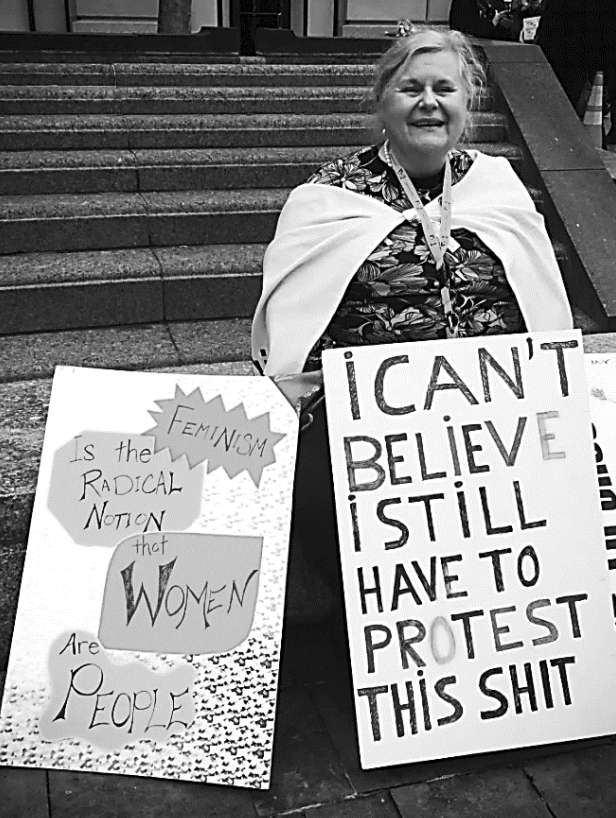
“Feminism Is the Radical Notion that Women Are
People” / “I can’t believe I still have to protest this
shit”
Photo from Women’s March in Washington DC, on January 2, 2017.
Weiter lernen mit SchulLV Plus!
monatlich kündbarSchulLV Plus-Vorteile im ÜberblickDu hast bereits einen Account?Please note: The solutions presented here are just one possible way to approach the task. There are often multiple valid methods and perspectives, and alternative approaches may be equally effective.
The article “60 Years After March on Washington, America’s Progress Hinges on Liberating Black Women” (2023) by Andrea Waters King and Jennifer Jones Austin examines the historical and contemporary position of Black women within the United States job market, illustrating how systemic racism and sexism have continually marginalized their economic contributions.
In the past, particularly leading up to and during the 1960s, Black women faced severe restrictions and devaluation within the American workforce. Their labor and societal contributions were frequently discounted or entirely undercounted by a predominantly male labor force (lines 17–19). Consequently, career opportunities for women of color were exceptionally scarce, limiting them almost exclusively to domestic labor, which constituted the lowest-paid occupation class at the time of the 1963 March on Washington (lines 19–20). Despite historical promises of equality and fair compensation dating back to the emancipation era, structural barriers ensured that Black women remained systemically undercompensated and mistreated (lines 11–16).
In the present day, although Black women are no longer legally restricted to domestic service, the text highlights that they remain significantly segregated within the labor force (lines 21–22). They continue to experience deep-seated occupational segregation, characterized by severe underrepresentation in high-paying professional fields and a heavy overrepresentation in lower-paying occupations, such as childcare and social work (lines 22–24). Although these social sector roles are vital to a healthy, functioning society, their average wages fail to cover basic living costs (lines 24–25). This wage deprivation is further compounded by systemic pay inequities and a massive accumulation of student loan debt, which hits Black graduates disproportionately harder than their white counterparts (lines 40–44). Furthermore, the modern job market often requires Black women to achieve significantly higher academic credentials to earn the same wages as white men. This persistent income inequity heavily impacts families, particularly because over half of all Black children currently live in households where Black women act as the sole breadwinners relying on a single, frequently insufficient income (lines 48–50). Despite centuries of institutional devaluation and having their worth diminished, Black women have continuously driven American progress, ranging from early universal suffrage reformers to modern-day medical scientists (lines 55–61).
In their essay, Andrea Waters King and Jennifer Jones Austin adopt a fiercely critical yet empowering attitude toward the socio-economic marginalization of Black women in the US. They argue that this intersectional injustice actively sabotages the progress of the entire nation. To convey this stance, the authors strategically blend historical framing, empirical data, and vivid imagery.
Historical Framing and Authority (Ethos)
The authors establish the gravity of the issue by opening with a powerful quote from 19th-century scholar Anna Julia Cooper (“Only the Black woman... enters with me”), positioning Black women as pivotal to racial liberation. By linking Cooper’s words to unfulfilled promises by Abraham Lincoln and Dr. Martin Luther King, Jr., the authors create a historical continuum. This underscores the frustrating longevity of systemic racism and infuses the text with a sense of historical urgency.
Empirical Evidence and Rhetorical Contrasts (Logos)
To condemn contemporary disparities, the authors rely heavily on hard facts and stark juxtapositions. They cite devastating economic statistics (e.g., an “average wage of just $36,300”) to illustrate the persistence of enormous inequalities. A powerful contrast highlights the hypocrisy of the labor market: roles held by Black women are “critical to a healthy and functioning society, yet their wages don’t even begin to cover basic living expenses.” Furthermore, the absurd comparison that Black women “must earn three times as many degrees” to match the income of white men exposes the deep unfairness of institutional sexism.
Structural Oppression and Vivid Imagery (Pathos)
The authors utilize syntactic enumeration (“Occupation segregation, wage deprivation, and debt accumulation”) to mirror the overwhelming, cumulative weight of systemic racism. This structural trap is further illustrated through an evocative metaphor: “As if on autopilot, the cycle of poverty repeats itself.” The phrase “on autopilot” implies an inescapable, mechanical cruelty built into society. To drive this point home emotionally, the authors contrast child poverty rates (one in three Black children vs. less than one in ten white children), shifting the tone to sharp moral condemnation.
Empowerment and Call to Action
Despite the grim analysis, the tone shifts to profound admiration and urgent advocacy in the final section. By highlighting the monumental contributions of Black women—from early universal suffrage leaders to Dr. Kizzmekia Corbett (COVID-19 vaccine)—the authors command respect and reject the narrative of mere victimization. The essay culminates in an ardent, conditional call to action: “If Black women were awarded the value they deserve, the entire nation would take an instrumental step forward...” This effectively frames the liberation of Black women not as a minority issue, but as a prerequisite for America’s collective progress.
The assertion that America’s progress hinges on the liberation of Black women highlights a crucial debate in modern socio-economics. While women of color have historically been marginalized, their contributions remain foundational to American society. This raises the critical question of whether U.S. social and economic advancement is inextricably linked to their recognition, or if national progress is primarily driven by broader, race-neutral mechanisms.
On the one hand, a compelling case can be made that the systematic appreciation of women of color is essential for sustainable national progress. Today, women of color constitute a significant and vital portion of the U.S. workforce, particularly in indispensable sectors like healthcare, education, and social services. Failing to recognize their worth through fair compensation directly perpetuates intergenerational poverty, heavily destabilizing families where these women often act as the sole breadwinners. Furthermore, true social progress remains a legal fiction as long as the U.S. violates its own democratic ideals of equality and liberty. Fully valuing their contributions, as demonstrated historically by civil rights pioneers and modern scientists alike, unlocks vast human capital and increases the purchasing power of millions, ultimately boosting the entire nation's economy.
On the other hand, traditional macroeconomic perspectives suggest that national advancement is multi-faceted and driven by factors independent of any single demographic group. Historically, the United States achieved immense technological innovation, industrial growth, and global economic dominance despite the systemic oppression of women of color. From this viewpoint, scientific breakthroughs, fiscal policies, and universal infrastructure investments are the true engines of prosperity. Additionally, some critics argue that focusing on identity-specific empowerment can worsen political polarization and create social divisions, whereas universal policies targeting poverty and education for all citizens might foster greater national unity.
Ultimately, while quantitative economic growth can occur through technological and financial policies alone, genuine societal progress cannot be decoupled from justice. A nation can never realize its fullest potential while systematically underpaying the very demographic that sustains its essential services. Therefore, long-term American prosperity is fundamentally bound to the recognition and fair treatment of women of color, turning a moral obligation into an economic imperative.
Still Marching: Why the Fight for Feminism is Far From Over
An elderly woman stands amidst a sea of protestors at the 2017 Women’s March, holding a sign that perfectly captures a widespread modern frustration. Her sarcastic commentary on the lack of gender equality reminds us of a bitter reality: decades after the second wave of feminism, women are still forced to take to the streets to demand basic rights. On this International Women’s Day, her image prompts us to re-evaluate our society. It forces us to ask a crucial question: Is feminist protest still an absolute necessity in today’s Western world, or have we reached a point where the movement has achieved its historical goals?
Arguments against the necessity of ongoing radical protests often point to the immense legal and cultural milestones achieved over the last century. In most Western nations, robust legal frameworks firmly protect women’s rights in education, employment, and healthcare. Legislation advancing equal pay and prohibiting gender discrimination is structurally institutionalized, and women in the West possess full autonomy over family planning and reproductive health. Furthermore, female representation in politics, corporate leadership, and STEM fields has risen to historic heights. This structural shift is mirrored by a profound cultural evolution. Public attitudes toward gender roles have modernized significantly, with men increasingly embracing caregiving responsibilities and actively participating in feminist discourse. Movements like #MeToo have created unprecedented global awareness surrounding sexual harassment, transforming societal norms and leading to tangible judicial reforms that protect women from systemic abuse.
Despite these undeniably positive shifts, a closer look beneath the surface reveals that systemic inequality remains deeply entrenched, rendering continued feminist protest vital. The gender pay gap persists across almost all major industries, and women continue to bear a disproportionate share of unpaid care work, a systemic disadvantage that is frequently exacerbated by inadequate parental leave and alimony regulations. Beyond economic disparities, the physical safety of women remains a pressing crisis, as rates of sexual harassment, domestic assault, and misogynistic violence remain alarmingly high. Furthermore, modern media and social networks continue to perpetuate toxic masculinity and restrictive gender stereotypes, constantly bombarding younger generations with harmful ideals. Most chillingly, however, is the recent rollback of long-established rights. The supreme court decisions limiting reproductive freedom in the United States serve as a stark warning that progress is never permanent.
Ultimately, the elderly woman's sign is a testament to the fact that legal equality on paper does not automatically translate into cultural and socioeconomic parity in practice. While the Western world has built the legislative machinery for equality, the everyday lived reality for millions of women still falls short. Feminist protests remain essential today, not only to chip away at the remaining glass ceilings and cultural stereotypes but, more urgently, to act as a crucial defense mechanism against political regressions. As long as progress can be rolled back, the streets will remain a necessary stage for change.