
Vorschlag A
Crimes against humanity
Aufgabe
While doing research on ways to commemorate victims of crimes against humanity, your American friend came across the photo of a sidewalk in Germany, which you can see on the right. Your friend would like to know more about the story behind it.
Based on the interview, write an email to your friend outlining the information on Gunter Demnig’s project and responses to criticism of the project. (Material)
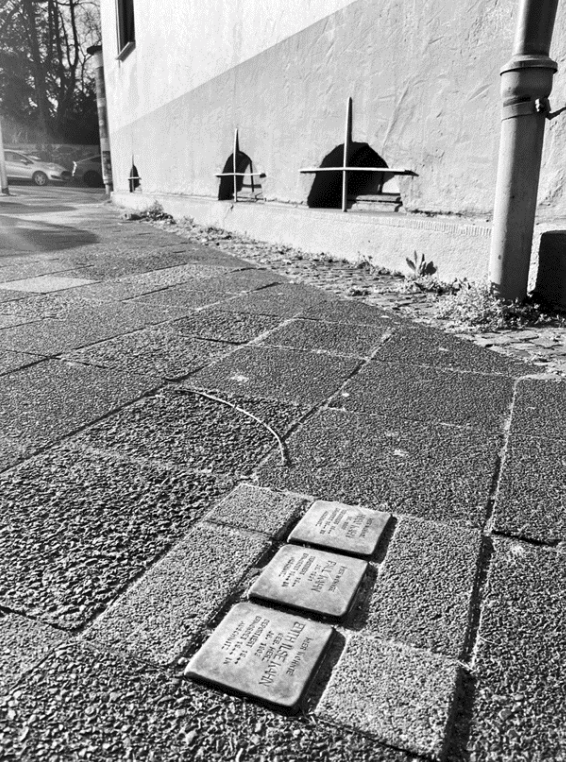
Material
Laura Dahmer: „Ein Mensch ist erst vergessen, wenn sein Name vergessen wird“ (2023)
(638 Wörter)
Laura Dahmer: „Ein Mensch ist erst vergessen, wenn sein Name vergessen wird“, in: Tagesspiegel, 09.11.2023. URL: https:// www.tagesspiegel.de/berlin/bezirke/berliner-stolperstein-erfinder-ein-mensch-ist-erst-vergessen-wenn-sein-name-vergessenwird-10748443.html (abgerufen am 02.06.2026).
Weiter lernen mit SchulLV Plus!
monatlich kündbarSchulLV Plus-Vorteile im ÜberblickDu hast bereits einen Account?Please note: The solutions presented here are just one possible way to approach the task. There are often multiple valid methods and perspectives, and alternative approaches may be equally effective.
Subject: The story behind the sidewalk photo: Germany’s "Stolpersteine" project
Hi Sam,
It’s great to hear from you! I'm really glad you came across that photo during your research, as it depicts a deeply moving and unique part of Germany’s commemorative culture.
The project you discovered is called "Stolpersteine", which literally translates to "stumbling stones." It was initiated by the German artist Gunter Demnig, and it has a fascinating, though tragic, background.
At its core, the project consists of small, cobblestone-sized concrete blocks capped with an inscribed brass plate. Each stone displays the name, birth year, and ultimate fate of a specific victim of Nazi persecution. What makes this project so profound is their location: they are laid directly into the sidewalk pavement right in front of the last chosen place of residence of these individuals before they were deported or murdered. Demnig’s guiding philosophy is that "a person is only forgotten when their name is forgotten." By integrating these memorials into everyday neighborhoods, the project serves as a constant, decentralized reminder that the atrocities of the Holocaust did not happen in some far-off place, but right on our doorsteps, involving people from our own communities.
What started with a single stone in Cologne back in 1995 has since evolved into the world's largest decentralized memorial. Today, there are over 105,000 stones across Europe, with Berlin alone hosting more than 10,000. It is a massive grassroots effort; local communities and school students are heavily involved in researching the victims' biographies, organizing funding through citizen donations, and taking on long-term maintenance sponsorships. Demnig considers this a form of "living history" that empowers the younger generation to understand the past so they can prevent such horrors from happening again.
However, despite its widespread acclaim, the project has also faced significant criticism and resistance. For one, some critics accuse Demnig of turning the installation into a mere repetitive routine. He strongly refutes this, emphasizing that it remains his ultimate life’s work, deeply rooted in the oppressive silence of his own upbringing. He notes that the emotional presence of the victims' descendants at the installations ensures it never becomes routine.
More significantly, the project faces moral opposition from within the Jewish community itself. Its most prominent critic, Charlotte Knobloch (former head of the Central Council of Jews in Germany), has called the project "unbearable." She argues that placing names on the ground invites passersby to metaphorically trample on the victims all over again, mimicking the degradation inflicted by the Nazis. Because of her objections, several
German cities have actually banned the installation of these stones, preferring memorials at eye level instead.
Demnig counters this criticism by pointing out that the physical reality of the stones tells a different story. Walking over the brass plates actually has a polishing effect, keeping them bright and visible. Furthermore, he
points out that in order to read the small inscriptions, passersby must physically bend down—a gesture that effectively forces them to bow in respect to the victim.
Lastly, there has been economic and legal resistance. Some landlords and real estate agents have opposed the stones out of fear that they might devalue properties or attract neo-Nazi vandalism. Demnig even won a prominent lawsuit in Cologne regarding this issue; the court ruled that because the stones are financed by public donations and placed on municipal ground, property owners have no right to block them.
It’s a complex and highly debated topic over here, but it truly shows how Germany continues to grapple with its history in daily life. I hope this gives you a good overview for your research! Let me know if you need any more details or further translations.
All the best,
Lena