
LS 2
Aufgabenstellung:
Outline the indications that the U.S. has a poverty problem.
Analyze how the author conveys his message. Focus on communicative strategies and use of language.
Choose one of the following tasks:
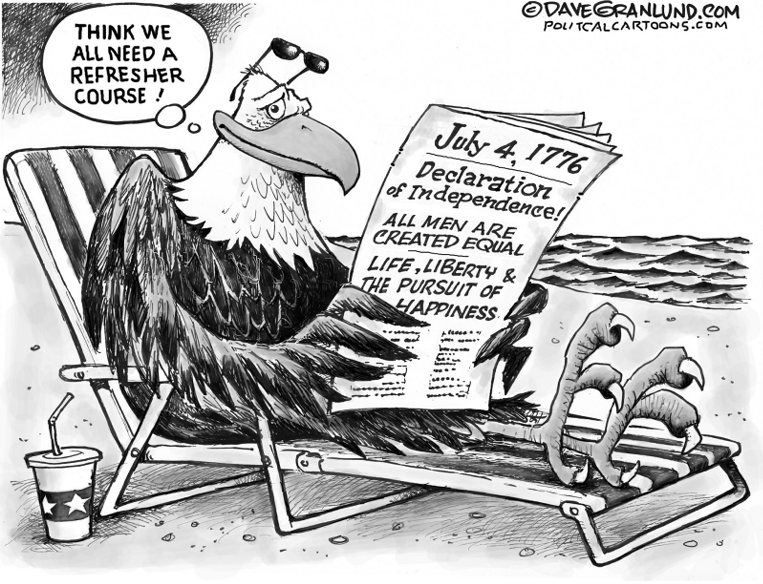
Taking the message of the cartoon as a starting point, discuss whether there is reason to celebrate the 250th anniversary of the Declaration of Independence on the Fourth of July 2026.
Bildliche Darstellung (Cartoon):
Dave Granlund, “July 4th Refresher Course”, in: cagle.com, 24 June 2024 https://cagle.com/cartoonist/
granlund/2024/06/24/286178/
july-4th-refresher-course (Zugriff: 07.03.2025)
Bildliche Darstellung (Cartoon):
Dave Granlund, “July 4th Refresher Course”, in: cagle.com, 24 June 2024 https://cagle.com/cartoonist/granlund/2024/06/24/286178/july-4th-refresher-course (Zugriff: 07.03.2025)
Write a letter to the editor, commenting on the author’s suggestions on how to eradicate poverty in the U.S.
Matthew Desmond
America Is in a Disgraced Class of Its Own
Annotations:
26 to accrue to someone – here: to benefit someone
43 quotidian – day-to-day
51-52 mortgage deduction windfalls – money homeowners save on taxes because they can subtract the interest they pay on their mortgages from their taxable income
54 milquetoast proposal – here: a mild suggestion
59-60 zoning laws – rules that dictate how land can be used and developed in specific areas
Matthew Desmond, “America Is in a Disgraced Class of Its Own”, in: The New York Times, 16 March 2023 https://www.nytimes.com/
2023/03/16/opinion/poverty-abolition-
united-states.html
(Zugriff: 01.03.2024)
Matthew Desmond, “America Is in a Disgraced Class of Its Own”, in: The New York Times, 16 March 2023 https://www.nytimes.com/2023/03/16/opinion/poverty-abolition-united-states.html
(Zugriff: 01.03.2024)
Wortzahl: 913
Weiter lernen mit SchulLV Plus!
monatlich kündbarSchulLV Plus-Vorteile im ÜberblickDu hast bereits einen Account?Please note: The solutions presented here are just one possible way to approach the task. There are often multiple valid methods and perspectives, and alternative approaches may be equally effective.
Matthew Desmond presents several indications that poverty is a serious and widespread problem in the United States.
First, economic hardship affects a considerable part of the population. A third of Americans live in households earning less than $55,000, and financial difficulties also affect people who are not officially classified as poor. Particularly vulnerable groups include elderly people, some of whom live in deep poverty.
Furthermore, although government programs such as housing assistance and food stamps help millions of people, the United States spends considerably less on such measures than other wealthy democracies. This becomes particularly apparent in international comparison: before the Covid pandemic, the American child poverty rate was approximately twice as high as that of countries such as Canada, South Korea and Germany.
Desmond also emphasizes the severe consequences of poverty for individuals. Poor people may suffer from health problems, debt, insecure housing and a shorter life expectancy. Poverty therefore affects not only people’s financial situation but also their health, opportunities and quality of life.
In addition, poverty is connected to structural inequalities. According to Desmond, wealthier Americans benefit from cheap goods and services, favourable tax policies and exclusive residential areas, while poorer people face disadvantages concerning housing and employment. Government policies may further reinforce this inequality, for example when financial benefits primarily support affluent homeowners while many poor renters receive no housing assistance.
Finally, poverty is also reflected in residential and educational segregation. Exclusionary housing policies contribute to concentrating disadvantaged people in particular neighbourhoods and limiting their opportunities.
Overall, Desmond presents American poverty as a widespread and structural problem that persists despite the country’s wealth and affects people economically, socially and physically.
In his article America Is in a Disgraced Class of Its Own, Matthew Desmond argues that poverty in the United States is not inevitable but a social and moral problem that Americans collectively help to maintain. His central aim is not only to inform readers about the extent of poverty but also to make them question their own role in perpetuating inequality and ultimately motivate them to support change. To achieve this, Desmond combines factual evidence with emotional language, direct reader involvement and a strong call to action.
At the beginning, Desmond establishes his central argument in the short and direct statement, “The United States has a poverty problem” (l. 1). Its simplicity immediately focuses the reader’s attention on the issue and leaves little room for ambiguity. He then supports his claim with statistics and international comparisons, which increase his credibility. For example, he points out that “more than one in 25” Americans aged 65 or older lived in deep poverty in 2021 (ll. 4–7). He also compares the United States with other wealthy democracies, stating that the American child poverty rate was “roughly double” that of countries including Canada, South Korea and Germany (ll. 12–13). This comparison is particularly effective because it challenges the idea that widespread poverty is unavoidable in a wealthy country. Instead, Desmond suggests that other developed nations manage the problem more successfully.
However, Desmond does not rely on facts alone. He uses emotional and vivid language to make readers understand what poverty actually feels like. He describes it as “an exhausting piling on of problems” (ll. 17–18) and lists “chronic pain”, “tooth rot”, “debt collector harassment” and “the nauseating fear of eviction” (ll. 18–20). This accumulation illustrates how different disadvantages reinforce one another. Moreover, the repeated structure “on top of […] on top of” (ll. 18–19) creates the impression of problems continuously accumulating without relief. The metaphors that poverty is “the suffocation of your talents and your dreams” and “a tight knot of humiliations and agonies” (ll. 19–23) emphasize that poverty restricts people’s opportunities and dignity. Thus, Desmond turns an abstract economic issue into a concrete human experience and appeals to the reader’s empathy.
A particularly important communicative strategy is Desmond’s use of inclusive pronouns and moral responsibility. Instead of blaming poverty only on politicians or institutions, he repeatedly uses “we”, stating that “many of us benefit from it” (l. 24) and that “we build and defend exclusive communities” (ll. 27–29). In this way, he includes himself and his audience in the criticism rather than positioning himself as morally superior. His accusation becomes especially forceful when he argues that Americans enrich themselves “by impoverishing others” (ll. 32–34). The antithesis between “enriching” and “impoverishing” highlights the connection between privilege and deprivation. His concise conclusion that poverty is not merely “a failure of public policy” but “a failure of public virtue” (l. 34) shifts the issue from politics to morality. The parallel structure makes this statement memorable and reinforces his claim that ordinary citizens also have responsibility.
Desmond then changes from criticism to mobilization. The sentence “we must commit to becoming poverty abolitionists” (l. 35) functions as a direct call to action. By deliberately connecting the fight against poverty with abolitionist movements against “slavery or mass incarceration” (ll. 36–38), he presents poverty as an unacceptable injustice rather than an inevitable part of society. The strongly negative noun “abomination” (l. 37) reinforces this moral framing. His medical metaphor also supports this idea: he argues that society must “stem the bleeding” while introducing measures that “target the disease” rather than merely “treat the symptoms” (ll. 40–42). Poverty is therefore represented as a serious but treatable condition requiring both immediate assistance and structural reform.
In the second half of the extract, Desmond increasingly addresses his readers directly and challenges their everyday behaviour. A sequence of rhetorical questions beginning with “What if” (ll. 47–53) encourages readers to imagine concrete alternatives, such as questioning tax advantages for homeowners or supporting antipoverty initiatives. Rather than discussing change only in abstract political terms, he shows how privileged individuals could reconsider their own behaviour. His statement that even this “milquetoast proposal” may appear “audacious, even radical” (ll. 54–55) is ironic: if a relatively moderate suggestion seems radical, this demonstrates, according to Desmond, how limited Americans’ expectations of social change have become.
Finally, Desmond uses metaphorical language and an increasingly urgent tone to turn his argument into a collective appeal. He argues that people must do the “hard work of tearing down the walls” around their communities (ll. 60–61). The “walls” represent both physical residential segregation and the social barriers separating rich and poor. In the conclusion, the inclusive pronouns become especially prominent: “the best hope we have” is to “bind ourselves together” (ll. 65–66), and “We can join them” (l. 67). This creates a sense of collective agency. The final antithesis – “not to reduce poverty but to end it” (ll. 68–69) – provides a memorable and forceful ending. It summarizes Desmond’s central message that gradual improvement is insufficient and that a wealthy country should aim to eliminate poverty altogether.
Overall, Desmond combines logos, pathos and direct moral appeal to persuade his audience. Statistics and international comparisons establish the scale of the problem, while vivid imagery communicates the human suffering caused by poverty. Inclusive pronouns challenge readers to recognize their own involvement, and rhetorical questions and calls to action encourage them to become part of the solution. In this way, Desmond transforms poverty from a distant socioeconomic issue into a shared moral responsibility and urges Americans to use their country’s wealth to create greater economic justice.
The Fourth of July 2026 marks the 250th anniversary of the Declaration of Independence – an event that seems to call for celebration. However, the cartoon by Dave Granlund questions whether the United States still lives up to the ideals it declared in 1776. It shows the American bald eagle reading the Declaration of Independence, including the famous principles that “all men are created equal” and have a right to “life, liberty & the pursuit of happiness”. The eagle thinks, “Think we all need a refresher course!”, suggesting that Americans have lost sight of these fundamental values. This raises an important question: Is the 250th anniversary really a reason to celebrate?
There are certainly good reasons to answer this question positively. The Declaration of Independence formulated ideals that have had enormous historical significance. Its emphasis on liberty and equality has influenced not only American democracy but also political movements around the world. Moreover, the United States has made considerable progress since 1776. Slavery was abolished, women gained the right to vote, racial segregation was legally dismantled during the Civil Rights Movement, and previously excluded groups gained greater political and social rights. From this perspective, the anniversary can commemorate both the ideals themselves and the generations of Americans who fought to make them more inclusive.
The United States also remains a democratic society in which citizens can participate politically, criticize their government and campaign for change. Freedom of speech, freedom of religion and other civil liberties are fundamental elements of American society. The fact that movements such as the Civil Rights Movement, Black Lives Matter or campaigns for LGBTQ+ rights can appeal to the country's own promises of equality demonstrates the continuing power of the Declaration's ideals. The document can therefore be understood not only as a description of America in 1776, but also as an aspiration against which the country can measure itself.
At the same time, however, the cartoon rightly points towards a considerable gap between American ideals and American reality. The claim that all people are equal was deeply contradictory from the beginning, since slavery continued after independence and women, Native Americans and many others were excluded from political participation. Although much has changed, inequalities have not disappeared. Racial discrimination, unequal educational opportunities and differences in access to healthcare continue to affect people's chances in life. Formal equality before the law does not automatically result in equal opportunities.
Economic inequality is another reason why an entirely uncritical celebration would be inappropriate. In one of the wealthiest countries in the world, millions of people continue to experience poverty, food insecurity or difficulties finding affordable housing. If a person's opportunities depend heavily on their parents' income, neighbourhood or access to education, the promise of an equal “pursuit of happiness” remains incomplete. The existence of enormous private wealth alongside homelessness and severe poverty raises legitimate questions about how equally American prosperity is actually shared.
There are also continuing debates about racism, immigration, reproductive rights and the rights of LGBTQ+ people. Such controversies show that the meaning of “liberty” and “equality” is still contested. The cartoon's idea of a “refresher course” is therefore effective: celebrating the Declaration should also mean remembering what its principles require from the present generation.
Nevertheless, these shortcomings are not necessarily arguments against celebrating the anniversary at all. A national anniversary does not have to imply that a country is perfect. In fact, the continuing struggle to extend rights to groups originally excluded from them can itself be considered part of the American democratic tradition. The Declaration has repeatedly provided language with which Americans could challenge injustice. The discrepancy between ideals and reality can therefore be a reason for critical reflection rather than for rejecting the anniversary altogether.
In conclusion, there is reason to celebrate the 250th anniversary, but the celebration should not become an exercise in uncritical patriotism. Americans can celebrate the democratic ideals formulated in 1776 and the progress achieved since then while simultaneously acknowledging the country's historical and present failures. The eagle's demand for a “refresher course” captures precisely what the anniversary should offer: an opportunity not merely to look proudly at the past, but to reconsider what “life, liberty and the pursuit of happiness” should mean for everyone in the United States today. The most meaningful way to honour the Declaration would therefore be not simply to celebrate its words, but to continue working towards fulfilling their promise.
Dear Editor,
Matthew Desmond is right about one fundamental point: widespread poverty in one of the richest countries in the world should not simply be accepted as inevitable. His call for Americans to become “poverty abolitionists” is deliberately ambitious, and many of his suggestions deserve serious consideration. However, ending poverty will require more than individual moral commitment. It also requires major political and structural reforms.
I particularly agree with Desmond that Americans need to reconsider policies that benefit the wealthy while poorer citizens receive insufficient support. His example of tax advantages for homeowners is convincing. It is difficult to justify generous subsidies for people who already own property while many low-income renters receive no housing assistance at all. Redirecting public resources towards affordable housing, food assistance, education and healthcare could therefore make a significant difference.
Desmond is also right to focus on residential segregation. Where people live strongly influences their access to good schools, employment, public services and safe environments. Exclusionary zoning can prevent low-income families from moving into communities with better opportunities. Supporting affordable housing in a wider range of neighbourhoods could therefore reduce the concentration of poverty and promote greater social mobility.
Another strength of Desmond's argument is that he does not place responsibility exclusively on the government. His suggestion that ordinary citizens should question their own privileges is uncomfortable but necessary. People cannot demand greater equality while simultaneously opposing every affordable housing project in their own neighbourhood. If Americans want a fairer society, their values cannot disappear as soon as their property values or tax advantages are involved.
Nevertheless, I am less convinced by Desmond's emphasis on individual actions such as homeowners donating their mortgage deduction savings. Such donations may help particular organizations and families, but voluntary generosity cannot replace reliable public policy. The fight against poverty should not depend on whether affluent individuals happen to feel charitable. Government has the ability – and responsibility – to create lasting structures that protect everyone.
For this reason, poverty reduction must also address wages and employment. People working full-time should be able to afford basic necessities. Measures such as adequate minimum wages, stronger protection for workers and greater access to affordable childcare could help families become economically secure. Investment in education and job training would additionally improve people's long-term opportunities instead of merely responding to emergencies after they occur.
At the same time, Desmond's language of “abolishing” poverty may appear unrealistic. No policy can guarantee that every person will always be financially secure. Yet this does not make his ambition meaningless. Political goals often require an ideal towards which society can work. Accepting poverty as unavoidable risks becoming an excuse for accepting conditions that could in fact be changed.
Ultimately, Desmond's most important contribution is his challenge to the way Americans think about poverty. Too often, poverty is treated either as the result of individual failure or as somebody else's problem. Desmond reminds us that economic structures are created by political choices and that privileged citizens may benefit from those choices.
The United States certainly has the resources to provide its citizens with greater economic security. Whether poverty can literally be abolished may be debatable, but reducing it dramatically is both possible and necessary. Desmond is therefore right to demand greater ambition. The real question is whether Americans are willing to turn moral concern into political action.
Sincerely,
Macy Thompson