
Text 1
Bearbeite eine Textaufgabe deiner Wahl.
Text 1
Could this secret, decaying railway be New York’s next urban park?

 154 million in grants from the
4 billion and balloon to 9 billion. The group has
400,000 to study the rail idea from the US Department of Transportation.
154 million in grants from the
4 billion and balloon to 9 billion. The group has
400,000 to study the rail idea from the US Department of Transportation.
(999 words)
Christopher Maag, “Could This Secret, Decaying Railway Be New York’s Next High Line?”, https://www.nytimes.com. From The New York Times, April 25, 2025 © 2025 The New York Times.
Annotations
1 Forest Hills, Ozone Park, Rego Park, Forest Park: neighborhoods in Queens
2 I-beam: a special kind of support beam
Outline the development of the Rockaway Beach Branch and the plans for its future use.
Analyze the writer’s portrayal of how both nature and humans reclaim the former train line. Focus on communicative strategies and use of language.
Choose one of the following tasks:
“One man can impose only so much order on a place so riotous. Rather than feel discouraged by the disorder, Mr. Mohamed greets it with delight. In summer, when the garden pruning is finished, he retires to his back deck. He watches darkness descend at its own celestial pace.” (ll. 72–75)
Taking this quotation as a starting point, comment on the importance of living in harmony with nature.
or
To mark World Cities Day, the United Nations Human Settlements Programme is collecting student perspectives on the future of urban life on its website.
Taking the message of the cartoon as a starting point, write an article in which you discuss whether cities should prioritize functionality and productivity over green spaces.
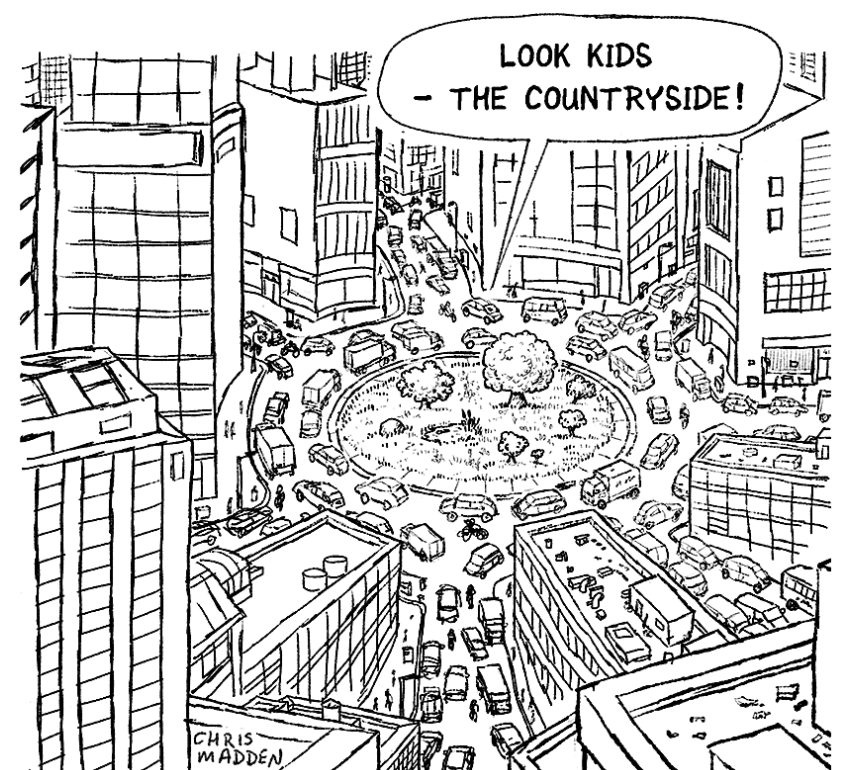
© Chris Madden / cartoonstock.com
Weiter lernen mit SchulLV Plus!
monatlich kündbarSchulLV Plus-Vorteile im ÜberblickDu hast bereits einen Account?In his article “Could This Secret, Decaying Railway Be New York’s Next High Line?”, published in The New York Times on 25 April 2025, Christopher Maag reports on the history and contested future of the Rockaway Beach Branch, an abandoned railway track in Queens. He explores how the transit link has been reclaimed by nature and has now become the centre of a debate over the future of urban space in New York City.
introduction
The Rockaway Beach Branch was originally a significant transit route for the Long Island Rail Road, providing a direct connection between Manhattan and the coastal areas of Queens. Since its abandonment in 1962, the three-and-a-half-mile line has undergone a total natural transformation. Over six decades of neglect, the manmade infrastructure has been overtaken by dense vegetation and wildlife, creating a secluded urban wilderness. While a small portion of the area is accessible to the public, the majority is closed off, though it continues to be used informally by local residents, explorers and homeless people.
history and current state of Rockaway Beach Branch
The future of the area is currently the subject of a debate over two competing visions. One proposal, led by the non-profit group “Friends of the QueensWay”, suggests converting the derelict line into a landscaped linear park. This initiative has already secured significant government funding to begin the initial phases of redevelopment. In contrast, the “QueensLink” advocacy group proposes the restoration of an active rail service to extend the city’s subway system. This alternative plan is associated with much higher costs, however, due to the significant investments in infrastructure required. Pending a decision, the land continues to be appropriated informally by neighbouring property owners, who have integrated parts of the surrounding nature into their private residential spaces and would not welcome either of the two ideas for redevelopment.
(296 words)
visions for future use
In his article, Christopher Maag cleverly blends the voices of various locals with his own subjective impressions of the abandoned Rockaway Beach Branch. He presents it as a secluded urban sanctuary, whose desolate state of decay only adds to its unique charm.
introduction
When it comes to the development of the former railway track, Maag depicts it from three different angles: the gradual but unrelenting takeover by nature, the current clandestine appropriation by daring individuals and the official plans for its future use.
main part: three kinds of reclamation
Nature is portrayed as an unyielding force that has claimed the industrial remains, integrating and transforming them into a new organic whole. Using personification when writing that “nature pursued its messy designs” (l. 6), Maag stresses this idea of unstoppable agency. He further elaborates on it in the paratactical sentences “Forests grew. Signal towers fell. Coyotes colonized the dark bramble” (ll. 6/7), which present a compressed timeline of what happened as soon as the railway service had been abandoned. The author makes no secret of his appreciation of nature’s work when he remarks that the track has only become “more strange and more beautiful” (l. 2) for its abandonment. He repeats the seeming paradox of “decayed beauty” (ll. 20/21) throughout his article – in line 37, for instance, when he asserts that the abandoned transit branch continues to “grow […] more beautiful for its disuse” and adds several contrasts of things trespassers can enjoy, namely “the infinite overlapping riot of things planted and dead, built up and falling apart” (ll. 38/39). Thus, Maag reframes the failure to maintain the tracks as a strictly positive development. When he describes the railway line as having come “unmoored” and “sway[ing] free in the wind” (ll. 8/9), his choice of language even suggests a kind of liberation from the prison of human engineering. The most striking – and perhaps symbolic – example of nature’s reclaiming of a manmade structure is the description of a little seedling that “fell between the stones”, grew into a maple tree and “caught the rail”, physically “folding the steel I-beam into its bulbous trunk” (ll. 9/10). Therefore, nature is not merely obscuring the ruins but actively consuming and restructuring them.
nature as an unyielding
and transformative force
When it comes to describing human efforts to reclaim the abandoned space, Maag draws on the stories of local residents. By sharing their subjective experiences, he offers the reader a glimpse of the magic hidden within the urban wilderness. Maag reveals his personal admiration, and perhaps a bit of anarchistic glee, when he contrasts the area’s uninviting (if not outright hostile) exterior of “razor wire, wobbly fences and hillsides of poison ivy” (ll. 13/14) with a resident’s joyful exclamation (cf. l. 16). The surreal delight of walking through a secluded forest in the middle of one of the world’s busiest cities is encapsulated by the same resident’s surprised realisation, “Wait, I’m in New York City!” (l. 18). Maag shares another aspect of how humans interact with the unkempt wilderness at their doorstep when he introduces Patrick Mohamed, whose “campaign of territorial expansion” (ll. 69/70) spans more than two decades and who has extended his “domain all the way across the first set of tracks” (l. 59). While this use of military terminology is certain to evoke images of a covert operation behind enemy lines, Maag pairs it with the more wholesome impression of a successful domestic project. When he describes Mohamed’s “[r]aised tomato beds” as “climb[ing] the hill like a staircase” (l. 56), he presents the residents’ informal appropriations as examples of human productivity thriving in an unsupervised environment. He drives this point home when he contrasts their creativity and agency with the dry standard process of “land rights [normally being] adjudicated to the square inch” (l. 60).
individual appropriation showing creativity and agency
This underlines one of the author’s key points: namely, that the urban wilderness which has so far been “hidden in plain sight” (l. 25) faces the looming threat that it “may not remain hidden for long” (l. 26) because of the plans for its future. Reporting on the desire of park developers “to utilize every inch” (l. 31) of it and citing dazzling amounts of money that would be required for different redevelopment projects (cf. ll. 28, 35/36), Maag contrasts the cold, economy-orientated official approaches with the thriving creativity that makes the area valuable as it is. When he uses a simile to describe blue jays that “march down the canopy like columns of soldiers” (l. 45), his choice of imagery suggests that nature has established its own structure and does not depend on human intervention to provide meaning. Thus, Maag’s article stresses the idea of a superior natural order, which is also illustrated in his almost poetic closing description of night falling “at its own celestial pace” (l. 75).
institutional planning as a threat to spontaneous beauty
Ultimately, Maag does not seek to exclude human presence from the environment. Mr Mohamed is presented as a role model for a functioning coexistence of nature and humanity. Greeting nature’s disorder with delight instead of attempting to fight it (cf. ll. 72/73), he embodies a harmony that Maag clearly admires. His article suggests that the abandoned railway line is a unique ecosystem worth preserving, thereby prioritising spontaneous beauty over any plans for a more structured, institutional use.
conclusion
(873 words)
The wisdom of letting darkness fall at its own pace
headline
Patrick Mohamed’s makeshift garden, carved piece by piece into the embankment of an abandoned railway line in Queens, is a small monument to a simple kind of wisdom: only a fool would try to master nature. A smart man, Mr Mohamed accepts that he can “impose only so much order on a place so riotous”, and rather than fighting a losing battle, he ends his evenings quietly, watching darkness “descend at its own celestial pace”. Mr Mohamed’s sense of contentment feels strangely out of place in the modern world – a world in which most of us have forgotten what it looks like to share our surroundings with nature instead of subduing it beneath layers of concrete and steel.
introduction
If you were to believe the viral content peddled by lifestyle influencers and survivalists, there are precisely two approaches to human interaction with nature: unchecked exploitation and complete surrender. Both framings are unhelpful. Mankind’s total domination of nature over the last two centuries has given us cities choked by concrete, collapsing ecosystems and global warming, while an escapist fantasy of total retreat conveniently ignores the fact that nature is just as capable of flooding a home, spreading disease or ruining a harvest as it is of sustaining life. That is why the human impulse to control one’s environment is not entirely unfounded. However, as Mr Mohamed’s example suggests, there is a sustainable path we can take which involves neither surrendering to nature nor attempting to subdue it. He does not aim to defeat the disorder around his garden – he simply makes peace with how much of it can reasonably be tamed.
main part:
false dichotomy
Living in harmony with nature in this way has value that exceeds merely being reasonable: it plays an important role in our well-being. Psychologists have long argued that we have a deep-rooted need for contact with the outdoors – a need that does not vanish because of the comfort afforded by a soft couch in an air-conditioned room. The simple act of walking through a forest has been linked to lower stress levels and an improved mood. Even people’s lifespan, which is said to be influenced mainly by diet and community, is also tied to daily routines built around outdoor physical work and the natural order of the seasons. Mr Mohamed’s evening ritual of watching the dark arrive instead of switching on a light reminds us of something modern life has quietly taken from most of us: the luxury of allowing our bodies to follow the rhythms they have evolved to expect.
individual well-being
The price of ignoring these natural rhythms extends well beyond the individual. Relentless industrial farming has led to widespread soil degradation, manmade climate change has multiplied the likelihood of environmental disasters and the unchecked expansion of urban infrastructure continues to fragment the very habitats that sustain biodiversity. Yet, where humans have chosen cooperation over conquest, the results are striking: rewilding projects across Europe have allowed rivers and forests to reclaim floodplains that levees once fought to suppress, easing flood risks downstream while restoring the habitats those levees had erased. At the same time, cities around the world have discovered that establishing car-free, low-emission zones or allowing nature to reclaim a derelict stretch of urban land does far more for a neighbourhood’s well-being than another stretch of concrete ever could. These examples suggest that coexistence is not a nostalgic indulgence but often the more resilient and, in the long run, more economical choice. After all, preventing ecological damage is consistently cheaper than repairing it afterwards.
systemic arguments for harmony
Ultimately, individual gestures of harmony – a garden, an evening spent watching the sky rather than a screen, a walk instead of a drive – can only go so far on their own. Mr Mohamed’s success – admirable as it is – does not extend beyond his domain; it is but a drop in the ocean of wilderness lost to development every year. That is why meaningful harmony with nature has to be pursued on a social level too, as a collective commitment to policies that preserve natural spaces. We need urban planning that protects green corridors, regulations that limit habitat destruction and incentives that reward leaving plots undeveloped.
individual vs systemic
Nevertheless, Mr Mohamed’s inspiring example can guide us on our way and teach an important lesson: more than any grand gesture, it is humility and prudence that we need. Only when we have learnt to limit our desire for control and order will we be able to live in harmony with a world that was never entirely ours to begin with.
conclusion
(760 words)
Let’s do away with an unnecessary choice: why a green city IS an efficient city
headline
The image presented in Chris Madden’s cartoon – a family circling a congested urban roundabout only for a parent to point at a tiny patch of trapped greenery and exclaim, “Look kids – the countryside!” – highlights a key dilemma of modern urban planning. While the scenario may sound like an absurd exaggeration today, it serves as a dire warning of a potential future where nature will have been almost entirely eradicated from the human experience, reduced to a curiosity glimpsed through a car window. It illustrates a mindset where nature is treated as a redundant luxury – one that is routinely sacrificed in the service of a narrow and increasingly outdated definition of “functionality” and “productivity”.
introduction:
reference to cartoon
In many of our modern cities, parks and other green spaces can indeed seem like a pleasant, but ultimately decadent waste of space that could otherwise be used more efficiently. When we think of the scarcity of housing that plagues many metropolises, for instance, discussions about how to make neighbourhoods greener will probably feel like a slap in the face for those who desperately need something as simple as a place to live in. Another issue is the necessity for cities to provide a well-oiled system of public transport. With demands on people’s time getting more and more pressing and the rhythm of life generally becoming faster, it is no wonder that a new railway line might seem to be the more urgent project to focus money and energy on in comparison to the next park or leisure area.
main part:
arguments for “productivity first” view
However, a city based on an overly narrow sense of efficiency risks a profound type of functional failure. If urban design ignores the psychological and physiological needs of a city’s inhabitants, it creates a landscape of emotional fatigue and social isolation while simultaneously compromising the physical health of citizens through noise and air pollution. With heat records being broken every year, one thing has become painfully clear: a city so densely packed with concrete that it turns into an inescapable heat island ceases to be an efficient place to live or work, no matter how smooth its traffic flow or how many thousands of people it can house. Residents who cannot sleep because of noise or who fall ill more often because of poor air quality are hardly the hallmark of a well-functioning city; instead, they represent a hidden cost that will eventually be paid for not just in lost productivity but in overcrowded hospitals – and morgues.
rejecting narrow sense of efficiency
Therefore, the idea that we have to choose between a “functional” city and a “green” city is not just false but completely absurd. In reality, green infrastructure is a common-sense functional necessity for the 21st century. As cities face increasingly intense heat waves and rising pollution, trees and parks provide essential relief by offering natural cooling and air filtration that would otherwise cost billions in energy and medical expenses; a mature tree canopy can noticeably lower the temperature of the street beneath it, helping to ease the strain on power grids during the hottest months. Far from being a drain on the public purse, these green spaces tend to raise the value of the property around them and make local businesses attractive for people to linger at rather than simply pass through. A green city is, by definition, a resilient and efficient city.
green infrastructure is a functional necessity
Ultimately, effective urban planning does not involve making a choice between economic and ecological considerations. Rather, it highlights their manifold synergies. As Madden’s roundabout suggests, integrating natural spaces should not be a mere afterthought limited to the decoration of traffic islands but a core consideration at every step of city development. True urban productivity must be measured by a city’s ability to sustain its environment and the well-being of its inhabitants – not merely by how many lanes of traffic can be fit around a dying tree.
conclusion
(653 words)