
Aufgabe 2.1
TASK
While doing research on ways to commemorate victims of crimes against humanity, your American friend came across the photo of a sidewalk in Germany, which you can see on the right. Your friend would like to know more about the story behind it.
Based on the interview, write an email to your friend, outlining the information on Gunter Demnig’s project and responses to criticism of the project.
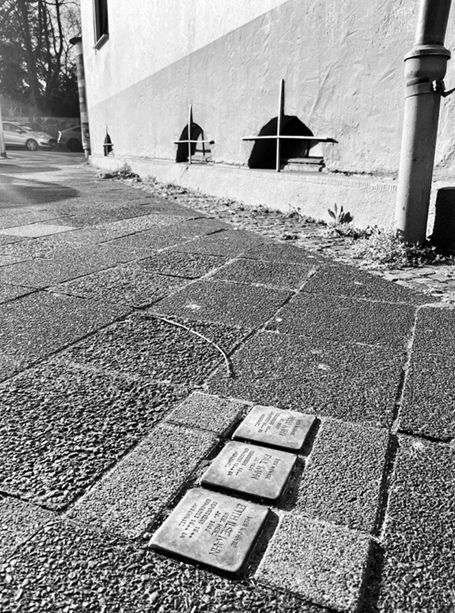
While doing research on ways to commemorate victims of crimes against humanity, your American friend came across the photo of a sidewalk in Germany, which you can see on the right. Your friend would like to know more about the story behind it.
Based on the interview, write an email to your friend, outlining the information on Gunter Demnig’s project and responses to criticism of the project.
TEXT
Auszug aus dem Interview
„Ein Mensch ist erst vergessen, wenn sein Name vergessen wird“
Von Laura Dahmer
(638 Wörter)
Dahmer, Laura. „Ein Mensch ist erst vergessen, wenn sein Name vergessen wird.“ Tagesspiegel. 9. Nov. 2023. Zugriff am 24. Okt. 2024 von https://www.tagesspiegel.de/berlin/bezirke/berliner-stolperstein-erfinder-ein-mensch-ist-erst-vergessen-wenn-sein-name-vergessen-wird-10748443.html. (Foto: privat)
Weiter lernen mit SchulLV Plus!
monatlich kündbarSchulLV Plus-Vorteile im ÜberblickDu hast bereits einen Account?Please Note: The solutions presented here are just one possible way to approach the task. There are often multiple valid methods and perspectives, and alternative approaches may be equally effective.
The Story Behind the Stolpersteine
Hi Hayley,
I hope you are doing well!
I’m glad you asked about the photo you found. The brass plates you saw in the sidewalk are called “Stolpersteine” (“stumbling stones”). They are part of a memorial project created by the German artist Gunter Demnig to commemorate victims of the Nazi regime.
The stones are small brass cubes placed into the pavement in front of the victims’ former homes. Each stone is engraved with the victim’s name and information about what happened to them. The idea behind the project is to bring the memory of these people back into everyday life and remind people that the victims once lived in the same neighborhoods as everyone else before they were deported and murdered by the Nazis.
Demnig laid the first Stolperstein in Cologne in 1995 to commemorate Sinti and Roma victims of Nazi persecution. Since then, the project has grown enormously. Today, there are more than 100,000 Stolpersteine all across Europe, making it the world’s largest decentralized memorial.
What is especially interesting is that local communities are actively involved in the project. Schools, citizens, and organizations often research the stories of victims, collect donations to pay for the stones, and help maintain them. Demnig himself says that many young people are very interested in learning more about Nazi crimes and preventing such events from happening again.
However, the project has also faced criticism. Some people believe that placing the names of victims on the ground is disrespectful because people walk across them. Charlotte Knobloch, an important representative of the Jewish community in Germany, argued that this symbolically means “stepping on” the victims again.
Demnig disagrees with this criticism. He explains that the brass surface becomes polished and shiny when people walk over it. He also points out that people who stop to read the inscriptions usually have to bend down, which can be seen as a gesture of respect. For him, the project is not just routine work but his life’s work because he wants to make sure the victims and their names are never forgotten.
There has also been criticism from property owners who feared that Stolpersteine could lower house prices or attract neo-Nazi vandalism. In one case, a lawyer even filed a lawsuit, but the court rejected it because the stones are privately funded and placed on public sidewalks.
Personally, I think the project is a very powerful form of remembrance because it connects history directly to everyday life.
If you want to find out more, just text me.
Miss you lots and see you soon!
Best wishes,
George