
LS 2
Aufgabenstellung:
Describe the situation at the hospital in Macclesfield as well as the state of the British health and care system as depicted in the article.
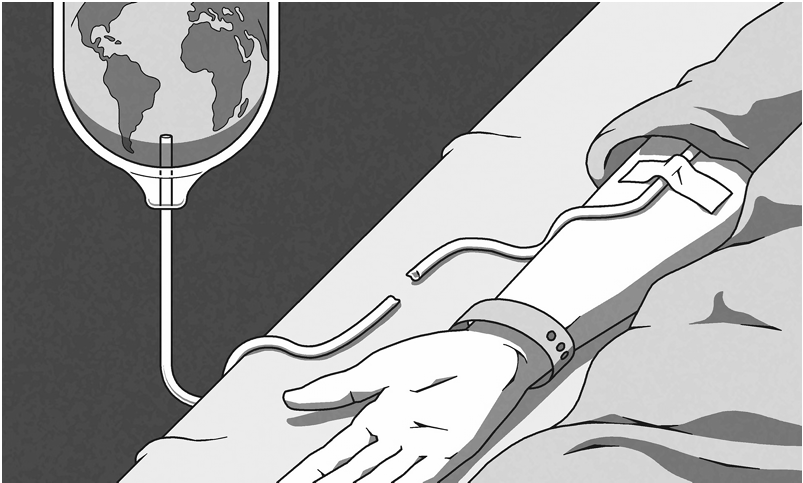
Analyze how the situation of the British health and care system is presented. Focus on communicative strategies and the use of language in the article as well as on the function of the picture published with it.
Choose one of the following tasks:
In his article Harris claims that, although they are not always appreciated, immigrants are a crucial part of British society. Referring to the text and reflecting on social and political realities in the United Kingdom, evaluate the chances and challenges of immigration for the United Kingdom.
In your social sciences class at a university in the UK you have talked about the modern world of work and the fact that recently programmes to enhance diversity in the workforce have increasingly been cut by politicians as well as companies. At the end of the semester each student is supposed to prepare a speech commenting on whether it is necessary to continue such programmes today. Write the script for your speech.
John Harris
In an NHS ward I saw how Britain relies on immigrants. Yet still we tell them they’re not wanted
(Matt Kenyon / The Guardian)
Annotations:
NHS (National Health Service) – the British public health care system run by the state
14 to be rushed off one’s feet – to be extremely busy
21 Mail, Express (Daily Mail, Daily Express) – national tabloid newspapers in the UK
28 dependent – here: family member relying on somebody for financial support
33 Care England – a charity organisation representing providers of social care in England
35 Westminster – here: the government of the UK
36 Kemi Badenoch – Member of Parliament for the Conservative Party and Leader of the Conservative Party since November 2024
36–37 her stance on immigration – Kemi Badenoch wants to make it more difficult for immigrants to settle permanently in the UK because she claims that immigration poses a threat to future generations.
43 to give “key workers” a vast round of applause – During the first months of the Covid pandemic, people showed their appreciation for health care workers by applauding at their open windows at set times.
John Harris, “In an NHS ward I saw how Britain relies on immigrants. Yet still we tell them they’re not wanted”, in: The Guardian, 16 February 2025 https://www.theguardian.com/commentisfree/2025/feb/16/nhs-britain-immigrants-dad
(Zugriff: 25.03.2025 – Die Unterzeile wurde ausgelassen.)
Wortzahl: 636
Weiter lernen mit SchulLV Plus!
monatlich kündbarSchulLV Plus-Vorteile im ÜberblickDu hast bereits einen Account?Please note: The solutions presented here are just one possible way to approach the task. There are often multiple valid methods and perspectives, and alternative approaches may be equally effective.
John Harris describes the hospital in Macclesfield as being under considerable pressure while still providing excellent care. His 89-year-old father is admitted after breaking his hip and initially has to wait an extremely long time for an ambulance. Despite another difficult winter for the NHS, however, his treatment at the hospital is very good. Most of the doctors and nurses caring for him are first-generation immigrants, particularly from African countries and India. Although they are extremely busy and overworked, Harris experiences them as patient, helpful and dedicated.
The situation at the hospital reflects a wider dependence of the British health and social care system on migrant workers. More than a quarter of NHS nurses and over a third of doctors are non-UK nationals. Similarly, almost a third of social care workers in England come from abroad.
At the same time, both sectors are suffering from serious staff shortages. Social care alone has around 130,000 vacancies. This also affects hospitals because many patients who are medically fit to leave cannot be discharged as the necessary social care is unavailable. As a result, about one in seven NHS beds is occupied by someone waiting for such care.
According to Harris, government immigration policies are making these problems worse. Migrant care workers are no longer allowed to bring dependent family members with them, which has contributed to a decline in applications for health and care worker visas. Thus, Britain relies heavily on immigrants to maintain its health and care services while simultaneously introducing restrictions that make the country less attractive to these essential workers.
Overall, Harris depicts the British health and care system as overstretched, understaffed and highly dependent on immigrant workers, whose contribution contrasts sharply with the increasingly hostile political debate surrounding immigration.
In his article, John Harris presents the British health and care system as severely strained and highly dependent on immigrant workers. At the same time, he criticizes the contradiction between this dependence and increasingly hostile attitudes towards immigration. To convey his message, Harris combines personal experience with statistics, contrasts, emotionally charged language and a striking visual metaphor in the accompanying picture.
From the beginning, Harris makes his position clear through evaluative and emotive language. He calls the situation a “bitter absurdity” (l. 1) and describes the debate about immigration as “toxic and hateful” (l. 2). These expressions immediately establish a highly critical tone. Moreover, he claims that without immigrants, basic care for “old, infirm and ill people would simply collapse” (ll. 3–4). The verb “collapse” emphasizes the seriousness of Britain’s dependence on foreign workers. By describing the political denial of this fact as “hypocrisy” (ll. 5–6), Harris establishes the central contradiction of his article.
He then uses a personal anecdote to make the issue more accessible and emotional. His 89-year-old father breaks his hip and has to endure a “terrifyingly long wait for an ambulance” (ll. 7–9), illustrating the pressure on the NHS. In contrast, Harris describes the treatment at the hospital as “faintly miraculous” (l. 10). Most of the doctors and nurses caring for his father are first-generation immigrants. Although they are “overburdened and rushed off their feet”, they treat Harris and his father with “amazing grace and patience” (ll. 13–15). This positive characterization creates sympathy and appreciation for immigrant healthcare workers while simultaneously showing how demanding their working conditions are.
Harris strengthens his message through contrast and irony. While immigrant doctors and nurses are caring for patients, the media around him repeatedly focus on the supposed dangers of immigration. Newspapers contain warnings about “influxes of foreigners” and portray Britain as “supposedly falling apart” (ll. 21–23). The word “supposedly” distances Harris from this view. More importantly, there is a clear irony in the situation: the people portrayed as a threat to Britain are actually helping to keep one of its most essential institutions functioning. This juxtaposition exposes the anti-immigration discourse as contradictory.
To show that his personal experience represents a wider problem, Harris uses statistics and factual evidence. He points out that 28% of NHS nurses and 35% of doctors are non-UK nationals (ll. 24–25), while the figure among social care workers may be as high as 32% (ll. 25–26). At the same time, restrictive immigration policies have caused a decline in health and care worker visas and applications (ll. 27–30). The consequences are particularly striking because around “one in seven NHS beds” is occupied by someone waiting for social care and the care sector has about “130,000 job vacancies” (ll. 30–32). The accumulation of figures gives Harris’s argument credibility and demonstrates the structural importance of migrant workers.
Furthermore, Harris strongly criticizes political rhetoric through emotionally charged language. He describes the atmosphere in Westminster as “grim” and “completely poisonous” (ll. 35–36). The metaphor of poison suggests that the political debate is actively damaging society. He then quotes Kemi Badenoch reducing care work to the question of “who’s going to wipe bottoms for us today” (ll. 37–39). The crude wording contrasts sharply with Harris’s earlier description of the dedication and professionalism of immigrant healthcare workers. By including the quotation, he highlights what he considers the lack of respect shown towards people performing essential care work.
Towards the end, Harris turns his argument into a moral appeal. He argues that when people depend on others for their “most essential needs”, the appropriate reaction should be “gratitude” (ll. 40–41). He then contrasts the present situation with the Covid pandemic, when “millions of us” applauded “key workers” (ll. 42–43). Now, however, politicians are telling many of these same people that they are “not wanted” or can remain only under “miserable and inhuman restrictions” (ll. 43–45). This contrast exposes a change from public appreciation to rejection. The inclusive pronouns “us” and “our” also involve British readers directly and encourage them to reflect on their own society’s attitude towards migrant workers.
The picture accompanying the article visually reinforces this central message. It shows a patient receiving an infusion, but the IV is connected to a globe instead of an ordinary medical bag. The globe functions as a metaphor for international support: just as the patient depends on the infusion, Britain’s health and care system depends on people from around the world. This directly reflects Harris’s claim that without immigrants basic care would “simply collapse” (ll. 3–4). The vulnerable patient further represents the weakened state of the NHS. Thus, the picture summarizes the article’s argument in a simple and memorable way and creates a strong contrast with the anti-immigration rhetoric Harris criticizes.
Overall, Harris combines personal experience, factual evidence, contrasts, emotive language and visual symbolism to present the British health and care system as overstretched but fundamentally dependent on immigration. By contrasting migrant workers’ essential contribution with hostile political rhetoric, he exposes what he considers a central hypocrisy in contemporary Britain and encourages readers to respond to these workers with appreciation rather than rejection.
Immigration has long been one of the most controversial political issues in the United Kingdom. As John Harris points out, however, the debate sometimes ignores how strongly British society already depends on people who have moved there from other countries. Immigration undoubtedly creates challenges, but its social and economic benefits make it essential to modern Britain.
One major advantage is its contribution to the labour market. Harris's example of the NHS demonstrates this particularly clearly: a significant proportion of doctors, nurses and social care workers are non-UK nationals. Without them, existing staff shortages would become even more serious. The same applies to other sectors in which migrant workers fill vacancies and contribute their skills. In an ageing society, immigration can also increase the working-age population and help provide services for a growing number of elderly people.
Immigration can furthermore enrich Britain socially and culturally. Modern British society has been shaped by generations of immigrants, including people from former colonies in the Caribbean, South Asia and Africa as well as migrants from Europe. Cities such as London demonstrate how immigration has influenced British food, music, arts and everyday life. Diversity can also encourage new perspectives and greater cultural understanding.
At the same time, immigration presents genuine challenges. A rapidly growing population can increase pressure on housing, schools, transport and healthcare, particularly if governments fail to expand public services accordingly. In areas already suffering from housing shortages or underfunded services, residents may therefore perceive immigration as additional competition for limited resources. Such concerns should not automatically be dismissed as xenophobia.
Integration is another challenge. Successful immigration requires opportunities to learn English, enter the labour market and participate in society. If communities remain socially separated or people experience discrimination, tensions can develop. The government therefore has a responsibility both to support integration and to ensure that migration is managed effectively.
Moreover, immigration has become a highly politicized issue. Brexit demonstrated how strongly concerns about migration and national sovereignty can influence political decisions. In recent years, debates about irregular migration and asylum seekers crossing the English Channel have further increased tensions. Politicians and the media have the right to discuss immigration critically, but presenting immigrants primarily as a threat risks increasing prejudice and ignoring their contribution to British society. Harris's article illustrates this contradiction particularly well: Britain depends on migrant healthcare workers while simultaneously introducing policies that may discourage them from coming.
There is also an important distinction between immigration itself and failures of government policy. If Britain lacks affordable housing, hospital beds or sufficient infrastructure, reducing immigration may appear to offer a simple solution. Yet many of these problems also result from long-term political decisions and underinvestment. Harris's example of social care is particularly revealing: restricting migration may actually worsen pressure on the NHS if there are then fewer care workers available.
Overall, immigration offers the United Kingdom more opportunities than disadvantages, provided that it is accompanied by effective policies. Britain needs immigration economically and benefits from it culturally, but integration, infrastructure and public confidence cannot be taken for granted. The challenge is therefore not to choose between unlimited immigration and closing the country off. Instead, the UK needs a fair and controlled migration system that recognizes legitimate concerns while treating immigrants as individuals and acknowledging the contribution they make. Harris's example of the NHS shows why this balance matters: a country cannot reasonably depend on people while simultaneously making them feel that they are not welcome.
Do We Still Need Diversity Programmes?
Good morning everyone,
Imagine two equally qualified people applying for the same job. One of them has a name the recruiter immediately recognizes. The other's name suggests a different ethnic background. Their qualifications are identical. Should their chances be identical too?
Of course they should.
But the more important question is: Are they?
Recently, diversity programmes in the workplace have increasingly come under pressure. Some politicians and companies argue that they are unnecessary, divisive or even unfair. If everyone is equal before the law, they ask, why should employers still need special programmes promoting diversity?
I believe the answer is clear: because equal rules do not automatically create equal opportunities.
Diversity programmes can help identify barriers that otherwise remain invisible. Recruitment procedures, promotion decisions or workplace cultures may disadvantage people because of their gender, ethnicity, disability, social background or other characteristics – sometimes without anyone deliberately intending to discriminate. Training, transparent recruitment procedures and mentoring programmes can help companies recognize such patterns and give talent a fairer chance.
And diversity is not only about fairness. It can also benefit organisations themselves. A workforce made up of people with different experiences and perspectives can approach problems from different angles. In an increasingly international economy, understanding different customers, cultures and markets can be a genuine advantage.
However, critics do raise an important concern. Diversity programmes become problematic if they turn individuals into categories or if demographic characteristics become more important than qualifications. Nobody should receive a job simply because they help a company meet a target. Such an approach could create resentment and undermine trust.
But that is an argument for better diversity programmes, not for abandoning them.
The goal should not be equality of outcome at any cost. It should be equality of opportunity. Employers can use structured interviews, transparent promotion criteria, accessible workplaces and outreach programmes while still selecting the best-qualified candidate. Merit and diversity are not opposites if everyone actually has a fair opportunity to demonstrate their merit.
We should also ask ourselves what happens if these programmes disappear. Does discrimination disappear with them? Do unconscious biases suddenly vanish? Do all employees immediately begin with the same opportunities?
Clearly not.
Our societies and workplaces have become increasingly diverse. Pretending that differences no longer matter will not make existing inequalities disappear. At the same time, diversity policies should be regularly evaluated rather than defended simply because they carry the label “diversity”. If a programme does not improve fairness or opportunity, it should be changed.
So, do we still need diversity programmes today?
Yes – but we need them to be effective, fair and focused on opportunity.
A modern workplace should not promise people success regardless of their abilities. It should promise something much more basic: that who you are will not prevent others from seeing what you can do.
And until we can genuinely make that promise to everyone, our work is not finished.
Thank you.