Lerninhalte
Inhaltsverzeichnis

Text

How our sleeping habits influence our lives
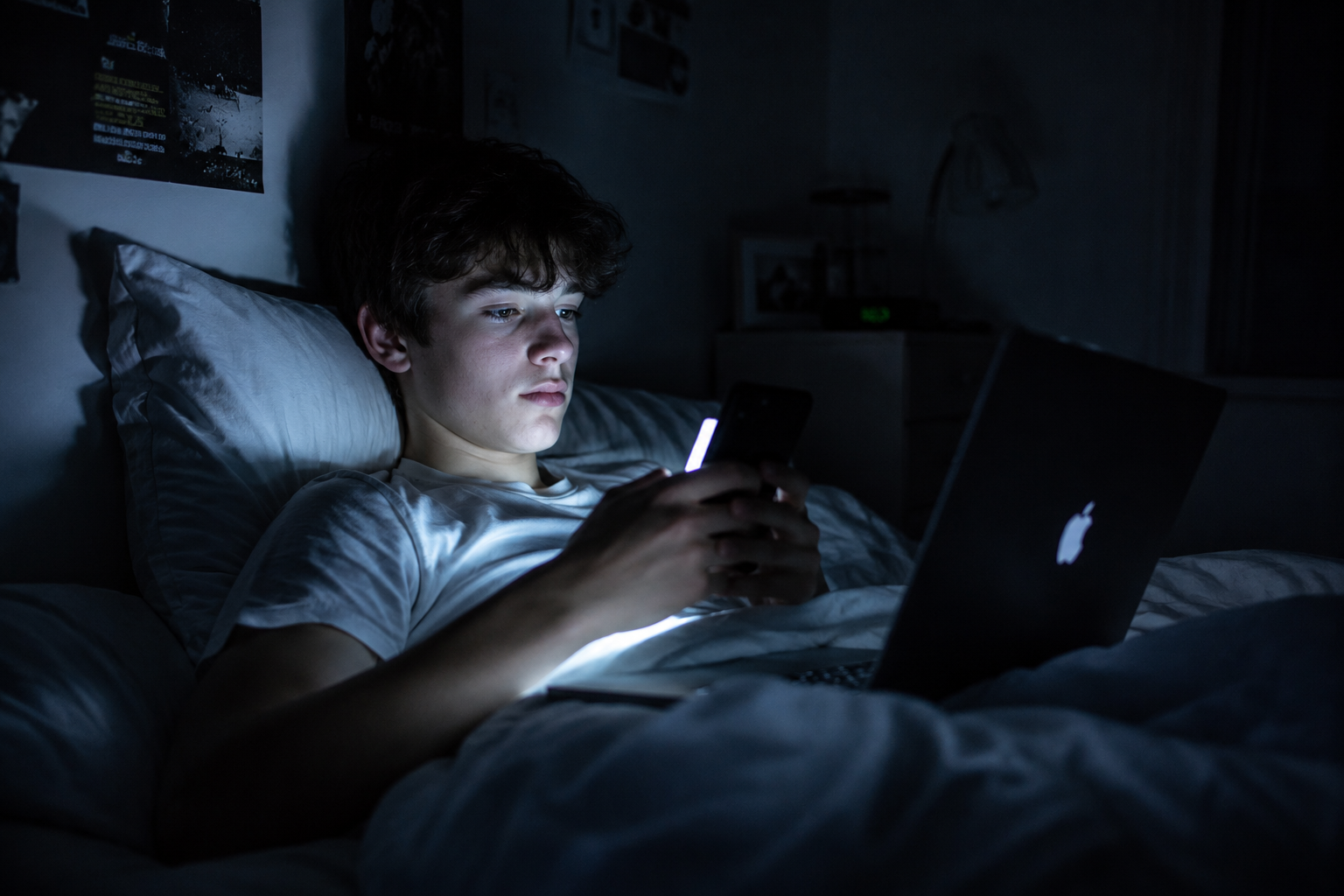
Teenager liegt nachts im Bett, blickt auf sein Smartphone, Laptop leuchtet neben ihm.Teenager liegt nachts im Bett, blickt auf sein Smartphone, Laptop leuchtet neben ihm.
1
No matter what your chronotype¹ is, getting enough sleep is
2
important for everybody’s physical and mental development.
3
Whereas some people are ‘early birds’, waking up early and
4
feeling energetic in the morning, others are ‘night owls’ who are
5
productive at night.

6
Usually, soon after the onset of darkness in the evening, the
7
sleep hormone melatonin is released and makes us sleepy. Its level rises, remains high
8
during the night and drops at dawn, when the lack of melatonin makes us wake up again.
9
Research shows that adolescents’ internal clocks are set to a schedule different from that
10
of younger children or adults. Due to hormonal shifts during puberty, melatonin production
11
does not start until around 11 pm and continues until at least 8 am. Therefore, teenagers
12
tend to fall asleep later, preferring to sleep longer in the mornings. Wide awake until late,
13
they want to be occupied and often reach for digital devices. This however makes falling
14
asleep even harder, as blue-lit screens slow down the production of melatonin.
15
“Sleep deficiency² is widespread among teenagers,” says sleep expert Herold Meyers.
16
“But especially deep sleep stages enhance learning, as both knowledge and experience
17
gained during the day are ‘replayed’ then. If considered important, information is finally
18
stored in the long-term memory, whereas less relevant aspects are deleted. This is why
19
having a good night’s sleep is just as crucial to high performance and good marks as
20
healthy nutrition and daily exercising.”

21
Sleep deficiency among teenagers results in physical stress, which can cause headaches
22
or even weaken the immune system. Many try to compensate for their sleep deficiency, by
23
‘bed rotting’ at weekends, which has become a common coping strategy. On Instagram,
24
users post videos of themselves bed rotting, showing them lying in bed all day. “However,
25
staying in bed for such a long time can make you even more sluggish than before. But as
26
long as this is not your only self-care tool, it is okay to take a bed rotting day every now
27
and then,” says Dr Jane Silver, a biologist.

28
“Without changing much in their sleeping habits, teenagers could also fight sleep defi-
29
ciency with short daily power naps. However, you should neither lie down nor take a nap
30
longer than 20 minutes in order to avoid deep sleep, as this makes falling asleep at night
31
even harder, contributing to sleep deficiency. Japanese inventors designed a cubicle³
32
which allows the user to sleep in an upright position and thus prevents people from enter-
33
ing deep sleep. We can learn a lot from Japan where the Inemuri, the practice of taking a
34
nap during working hours, is highly accepted, boosting efficiency at work,” Dr Silver adds.

35
When you finally turn into an adult around the age of 20, you return to earlier and more
36
stable sleep patterns. At that age, you could join The 5AM Club, an idea based on a book
37
with the same title, published in 2018. It suggests getting up at 5 am in the morning to
38
spend an hour alone and follow a strict routine of certain activities.

39
The author recommends splitting the hour into three blocks of 20 minutes: the central
40
aspect is meditating but before this, members do some physical exercises. The final
41
block is spent on developing new skills. Fans of the trend stress the benefits of this
42
routine, which helps them increase not only their fitness but also their productivity.

43
The right sleeping habits are the key to a happy and productive life – something children
44
should learn about early and thus should be discussed in schools.

(592 words)

Adapted from [https://www.ncbi.nlm.nih.gov/books/NBK222804/ (23.10.2024);

https://sleepwelldrinks.com/2022/09/28/why-does-my-teenager-go-to-bed-so-late/ (23.10.2024);

https://www.sleepfoundation.org/teens-and-sleep (23.10.2024);

https://www.betterhealth.vic.gov.au/health/
healthyliving/teenagers-and-sleep (23.10.2024);

https://breakingnewsenglish.com/2309/230925-vertical-napping.html (23.10.2024);

https://www.news4teachers.de/2024/10/
schlafforscher-fordern-schueler-besser-
aufklaeren-welche-folgen-schlafmangel-fuers-lernen-hat/ (23.10.2024);

https://institutions.newscientist.com/article/
mg18524811-700-bedtimes-could-pinpoint-the-end-of-adolescence/ (23.10.2024);

https://pmc.ncbi.nlm.nih.gov/articles/PMC4762453/ (09.12.2024);

https://www.nytimes.com/2008/01/14/opinion/
14kalish.html (09.12.2024);

https://www.bbc.co.uk/science/humanbody/body/
articles/lifecycle/teenagers/sleep.shtml (09.12.2024);

https://solportal.ibe-unesco.org/articles/sleep-learning-and-school-start-times-in-adolescence/ (09.12.2024);

https://www.ecosa.com.au/blog/post/inemuri-the-japanese-art-of-sleeping-at-work.html?srsltid=Afm-BOoprgTotIhIFxxwX_
ES2pgXaLP0FSS7DJE6UXqzNv3br5w9o05Vyh (09.12.2024);

https://www.nhlbi.nih.gov/health/sleep-deprivation (09.12.2024);

https://www.uclahealth.org/medical-services/sleep-disorders/patient-resources/patient-education/sleep-and-teens (09.12.2024);

https://sleepforsuccesswestport.com/the-science (17.03.2025);

https://my.clevelandclinic.org/health/diseases/
23970-sleep-deprivation (17.03.2025);

‘Read On’ (01/2024), Eilers & Schünemann Verlag KG, Bremen;

‘Read On’ (10/2024), Eilers & Schünemann Verlag KG, Bremen;

picture source: (Note: This image was created with the help of AI and does not originate from the original examination. The illustration used here serves as a content-equivalent alternative to the version shown in the exam.)]

Weiter lernen mit SchulLV-PLUS!

monatlich kündbarSchulLV-PLUS-Vorteile im ÜberblickDu hast bereits einen Account?

SchulLV