
Teil A: Schreiben
Wahloption 1
Aufgabenstellung
Outline the information on the protagonist’s personal circumstances and job.
Analyze how the protagonist’s state of mind is conveyed in the text.
Focus on narrative techniques and use of language.
Choose one of the following tasks.
“He knows that […] the moment is coming when he will feel the need to move on again, but until that need ripens into a necessity to act, he is content to remain in the present and not look ahead.” (ll. 41-43)
Taking the approach described in the quotation as a starting point, comment on strategies for individuals to cope with challenges of our time.
or
An international sustainability magazine is holding the writing competition “Rethinking our habits”. Participants are asked to submit articles responding to a visual.
Taking the picture as a starting point, write your article discussing the feasibility of creating a waste-free future.

https://www.pixtastock.com/photo/112219039
[accessed: 09 September 2026]
Material
Paul Auster: Sunset Park
The novel is set during the global financial crisis of 2008, which involved a housing market crash.
996 words
Auster, P. (2010).Sunset Park. London: Faber and Faber. pp. 3-7.
Wahloption 2
Outline the indications that the U.S. has a poverty problem.
Analyze how the author conveys his message.
Focus on communicative strategies and use of language.
Choose one of the following tasks.
Write a letter to the editor, commenting on the author’s suggestions on how to eradicate poverty in the U.S.
or
Taking the message of the cartoon as a starting point, discuss whether there is reason to celebrate the 250th anniversary of the Declaration of Independence on the Fourth of July 2026.
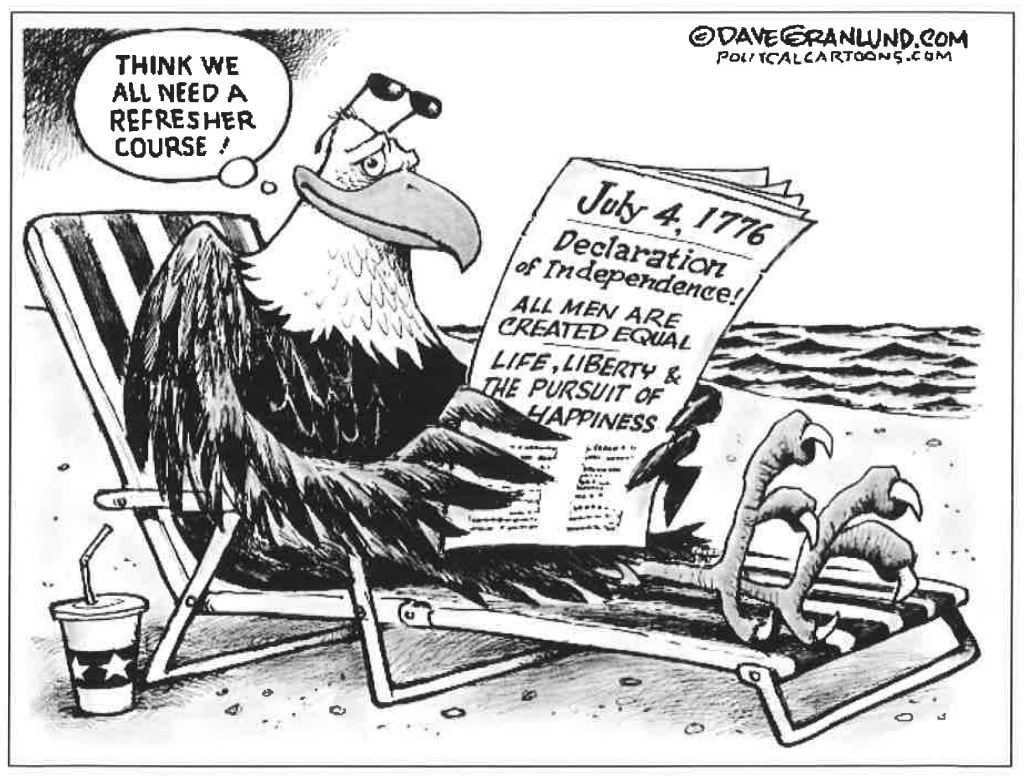
Dave Granlund: July 4th refresher course. Cagle.com. 24 June 2024.
https://cagle.com/cartoonist/granlund/2024/06/24/286178/july-4th-refresher-course
[accessed: 09 March 2026]
Material
Matthew Desmond: America Is in a Disgraced Class of Its Own
1to accrue to someone –here: to benefit someone
2quotidian – day-to-day
3mortgage deduction windfalls – money homeowners save on taxes because they can subtract the interest they pay on their mortgages from their taxable income
4milquetoast proposal –here: a mild suggestion
5zoning laws – rules that dictate how land can be used and developed in specific areas
913 words
Desmond, M. (2023). America Is in a Disgraced Class of Its Own.The New York Times. 16 March 2023.
https://www.nytimes.com/2023/03/16/opinion/poverty-abolition-united-states.html.
[accessed: 1 March 2024]
Mit SchulLV Plus weiterlernen
Schalte alle Prüfungsaufgaben, Lösungen und Lerninhalte frei – alles an einem Ort.
Monatlich kündbar
Please note: The solutions presented here are just one possible way to approach the task. There are often multiple valid methods and perspectives, and alternative approaches may be equally effective.
Wahloption 1
The excerpt from Paul Auster’s novel Sunset Park provides insights into the personal background and current job of its twenty-eight-year-old protagonist. Having dropped out of college seven and a half years ago, he lives on his own in a small, inexpensive apartment situated in a poor neighborhood in Florida. The protagonist practices extreme self-discipline by drastically minimizing his personal desires and financial needs. He does not smoke, drink alcohol, eat out in restaurants, or own digital media such as a television, radio, or computer. His few personal belongings consist of a digital camera, a car, a cell phone required for his employment, and a collection of paperback books, which he regards as an indispensable necessity. The protagonist earns a living working for a real estate company as part of a four-man crew engaged in "trashing out." Their daily responsibility is to clear out foreclosed residential properties that were abandoned by families in the wake of the 2008 financial crisis. On a daily basis, the crew cleans and repairs between two and seven vacated homes to prepare them for resale by local banks.
Through a third-person limited narrative perspective, the text grants deep access to the protagonist's internal feelings, detachment, and peculiar state of mind. It becomes evident that he feels an overwhelming emotional obligation toward the vanished families, compelling him to document their abandoned belongings. The narrator highlights this through explicit statements about his "obsessive picture taking" (ll. 28–29) and an extensive enumeration of photographed objects, ranging from "books, shoes, and oil paintings, pianos and toasters" to "silk lingerie, caulking guns [...] and a dead canary" (ll. 21–24). This elaborate list underscores his inner urge to preserve the last traces of human presence before they are discarded.
Furthermore, the protagonist’s state of mind is characterized by a conscious embrace of a plain, monotonous daily existence. The narrator utilizes declarative sentences, noting that "he has cut out smoking and drinking, he no longer eats in restaurants" (ll. 50–52), alongside parallelisms and anaphora: "To have no plans, which is to say, to have no longings or hopes, to be satisfied with your lot, to accept what the world doles out..." (ll. 47–49). These structural choices mirror his highly controlled, repetitive lifestyle and his deliberate choice to live strictly in the present without future ambitions (ll. 39–40).
His emotional isolation and disdain for his co-workers are conveyed through a dismissive tone and derogatory nicknames, as he labels them "Brain-dead Victor," "chatterbox Paco," and "fat, wheezing Freddy – the three musketeers of doom" (ll. 30–32). A sharp contrast is drawn between the crew members, who greedily loot discarded items, and the protagonist, who seeks "not things, but the pictures of things" (l. 36), illustrating his profound detachment from material gain.
His coping mechanism of extreme frugality is further reinforced through metaphors such as "bedrock necessities" (l. 58) and describing reading as "an addiction he has no wish to be cured of" (ll. 60–61). Finally, irony is employed to describe his state of mind, observing that while living without goals "might not be the most laudable accomplishment," it requires "considerable discipline and self-control for him to achieve it" (ll. 45–47).
In the excerpt, the protagonist adopts a philosophy of focusing strictly on the here and now, waiting "until that need ripens into a necessity to act" (ll. 41–43) rather than worrying about an uncertain future. When considering the complex challenges of the contemporary world—such as climate change, geopolitical conflicts, economic instability, and digital overload—individuals can adopt various strategies to cope, ranging from proactive resilience to passive self-preservation.
On the one hand, a constructive approach to modern challenges involves building personal resilience and practical competencies. Instead of feeling overwhelmed by global crises beyond individual control, individuals can focus on their immediate sphere of influence. This includes fostering strong personal relationships, engaging in community initiatives, and aligning daily habits with personal values, such as practicing sustainable consumption or mindful media use. Developing adaptability and practical skills empowers individuals to respond effectively when action becomes necessary, promoting mental well-being and a sense of agency.
On the other hand, adopting the protagonist's mindset of radical present-focused detachment carries both benefits and severe limitations. Temporarily scaling back expectations and focusing on immediate realities can prevent chronic anxiety and burnout caused by global uncertainty. However, relying solely on waiting for a "necessity to act" (l. 42) can easily slip into passivity, indifference, or escapism. Ignoring systemic issues until they force immediate action leaves individuals unprepared for long-term structural changes. Furthermore, resorting to fatalism or placing blame on external factors prevents meaningful civic engagement, which is essential for solving societal challenges.
Ultimately, while anchoring oneself in the present provides emotional stability, combining mindfulness with deliberate forward planning remains the most effective strategy for navigating modern life.
Rethinking Our Habits: Can We Build a Waste-Free Future?
The striking image of a stylishly dressed woman carrying shopping bags while standing atop a towering mountain of garbage starkly illustrates the core contradiction of modern consumer society. This surreal photomontage confronts readers with the hidden environmental costs of our disposable culture, raising a crucial question: is a waste-free future genuinely feasible, or is it a utopian illusion?
There are several compelling reasons to believe that a waste-free future is attainable. First, societal and individual awareness regarding pollution and resource depletion has grown significantly in recent years. More consumers are actively adopting sustainable habits, such as buying unpackaged goods, choosing reusable items, and reducing overall consumption. Second, technological and scientific advancements in circular economy practices, biodegradable materials, and automated waste sorting offer innovative pathways to eliminate waste. Furthermore, international legislation and corporate accountability programs are increasingly pressuring industries to design products meant for repair and recycling rather than disposal.
However, significant obstacles suggest that eliminating waste entirely remains highly unrealistic in the near term. Deeply ingrained consumer habits driven by convenience and aggressive marketing make radical lifestyle changes difficult for the general public. Additionally, economic systems prioritize continuous growth and profit, often making eco-friendly or zero-waste products less accessible and more expensive than conventional mass-produced goods. In many regions, inadequate recycling infrastructure and a lack of political will further hinder systemic reform.
In conclusion, while achieving a completely waste-free society may be an impractical ideal, striving toward it is indispensable. Significant waste reduction is achievable if governments, corporations, and individuals collectively commit to systemic economic transformation and responsible habits.
Wahloption 2
In his article "America Is in a Disgraced Class of Its Own," Matthew Desmond presents multiple indicators of a pervasive poverty problem in the United States. Financially, one-third of the population lives in households earning under 
 55,000, creating widespread economic hardship even for families above the official poverty line. Deep poverty is particularly prevalent among the elderly, with more than one in 25 Americans aged 65 or older lacking the means to cover basic needs. Furthermore, U.S. child poverty rates are roughly double those of comparable Western democracies like Canada and Germany. Desmond notes that American social safety nets, such as food stamps and housing assistance, receive far less funding relative to GDP than those in peer nations, resulting in visible "American-style deprivation" (l. 16). Beyond statistics, poverty manifests as physical and psychological suffering, including chronic health issues, debt harassment, and a widening life-expectancy gap between wealthy and impoverished individuals. Finally, spatial and social segregation reinforces this divide, isolating low-income families in underfunded neighborhoods and schools.
Throughout the article, Matthew Desmond employs a range of communicative strategies, rhetorical devices, and emotive language to persuade readers that U.S. poverty is an urgent moral failing requiring immediate collective action.
From the outset, the author establishes the gravity of the issue through a provocative headline, "America Is in a Disgraced Class of Its Own," paired with a blunt opening assertion: "The United States has a poverty problem" (l. 1). To reinforce his critique, Desmond utilizes negatively connoted terms such as "disgraced" (l. 11), "public decay" (l. 15), and "abomination" (l. 37). He incorporates an international perspective by quoting Europeans who speak of "American-style deprivation" (l. 16), exposing how the nation's social deficit is viewed abroad. Furthermore, he grounds his argument in objective statistics—noting that a third of the population earns under 55,000 (l. 2) and that over one in 25 seniors lives in deep poverty (l. 5)—to underline the magnitude of the crisis. To highlight societal damage, Desmond draws on a medical lexical field, using words like "bleeding," "disease," and "symptoms" (ll. 41–42) to emphasize that poverty is a systemic illness.
To move the reader beyond cold figures and evoke deep empathy, Desmond uses vivid imagery and structural repetition. Through anaphora and enumeration, he defines poverty as "an exhausting piling on of problems," listing "chronic pain, on top of tooth rot, on top of debt collector harassment" (ll. 17–18) and declaring it to be "the suffocation of your talents and your dreams" (l. 19) and a "tight knot of humiliations and agonies" (l. 22).
Crucially, Desmond holds wealthier citizens morally accountable. Using antithesis, he states that Americans are "enriching ourselves by impoverishing others" and asserts that poverty is a "failure of public virtue" (ll. 33–34). He compares the push for economic justice to historical "abolitionist movements against slavery or mass incarceration" (l. 36), framing poverty eradication as a fundamental human rights duty. Finally, he uses a series of hypothetical questions beginning with "What if..." (ll. 47–50) alongside concrete action steps—such as lobbying neighbors and attending zoning meetings (ll. 61–64)—to challenge readers' complacency and inspire active civic involvement, culminating in a passionate call to "end it" (l. 69).
Dear Editor,
Matthew Desmond’s compelling article "America Is in a Disgraced Class of Its Own" offers a sobering critique of systemic poverty in the United States and calls for a bold movement of "poverty abolitionism." While his moral urgency is commendable, his proposals for wealth redistribution and individual action deserve a realistic evaluation regarding their feasibility.
Desmond rightly argues that eradicating poverty requires systemic reforms rather than superficial fixes. His call to redirect tax privileges—such as the mortgage interest deduction—toward affordable housing and social initiatives is both logically sound and economically beneficial. Reinvesting in public services and lower-income households would stimulate economic growth, enhance social stability, and reduce the long-term societal costs associated with inequality and poor health. Furthermore, encouraging wealthy individuals to voluntarily donate tax windfalls and support inclusive zoning laws addresses the moral obligation of prosperous communities to foster integration.
However, Desmond’s vision faces immense political and cultural hurdles. In a nation deeply attached to the narrative of the American Dream, where individual success and property rights are paramount, convincing affluent citizens to surrender tax advantages or welcome affordable housing in their neighborhoods is exceptionally difficult. Deep political polarization and the heavy influence of corporate lobbies in Washington render sweeping legislative redistribution highly improbable in the near future. Moreover, relying on voluntary individual sacrifices is insufficient to counteract structural inequality on a national scale.
In conclusion, while Desmond’s radical proposal provides a necessary moral compass for public debate, achieving poverty abolition will require pragmatic political compromises alongside visionary idealism.
Yours faithfully,
Lily Wright
Should America Celebrate Its 250th anniversary in 2026?
As the United States reaches the 250th anniversary of the Declaration of Independence on July 4, 2026, the occasion invites both celebration and critical introspection. Dave Granlund’s political cartoon captures this tension vividly: the American Bald Eagle, lounging in a beach chair with a copy of the 1776 document, thoughtfully remarks, "Think we all need a refresher course!" This satire highlights a growing disconnect between the nation’s founding ideals and its contemporary reality, prompting the question of whether there is genuine cause for celebration.
On the one hand, the anniversary offers a vital opportunity for national renewal and civic reflection. Commemorating 250 years of independence allows educational institutions, civil rights organizations, and citizens to revisit core democratic principles such as equality, liberty, and the pursuit of happiness. In an era of intense political polarization, celebrating shared democratic heritage can foster national unity and reinforce civic commitment. Furthermore, highlighting America's enduring democratic achievements provides a symbolic beacon of hope for international movements striving for freedom and human rights worldwide.
On the other hand, widespread celebration risks ignoring systemic failures and historical hypocrisies. The founding assertion that "all men are created equal" stood in stark contradiction to the realities of slavery, the displacement of Indigenous populations, and the denial of women’s rights—injustices whose legacies persist in modern economic inequality and racial disparities. Critics argue that extravagant national festivities represent hollow patriotism when millions of Americans continue to face poverty, disenfranchisement, and restricted social mobility. Moreover, there is a risk that the anniversary will be commercialized or exploited by political factions to advance partisan agendas, deepening existing societal divides.
Ultimately, the 250th anniversary should not be a moment of uncritical self-congratulation, but rather a catalyst for action. By treating the milestone as a "refresher course" in foundational values, the United States can honor its history while actively working to fulfill the promise of equality for all its citizens.
Mit SchulLV Plus weiterlernen
Schalte alle Prüfungsaufgaben, Lösungen und Lerninhalte frei – alles an einem Ort.
Monatlich kündbar