Lerninhalte
Inhaltsverzeichnis

Part C

Men in space – and the women no longer in their shadow

1
When Neil Armstrong successfully landed on the moon in 1969, his words “That’s one
2
small step for a man, one giant leap for mankind” were quoted quickly all over the world.
3
Millions of people watched him and Buzz Aldrin, the second man on the moon, walk
4
around on the surface of the moon, making it the biggest television event that had ever
5
been broadcast. At that time, space travel, and especially the US program called Apollo,
6
seemed to be completely in the hands of men. But quite a few remarkable women were
7
involved in making space travel, and this famous first moon landing, possible.

8
There were not many women working at the US space agency NASA in the early sixties;
9
they made up only about 5 % of its workforce. Some of them, however, played an im-
10
portant role in getting astronauts into space. Their jobs included spacecraft design, doing
11
calculations for space flights, or developing software for the upcoming computer tech-
12
nology. Women also played an important role in medical research or in monitoring the
13
astronauts’ health.

14
A famous movie depicts the true story of three female mathematicians who were the
15
brains behind US astronaut John Glenn’s space flights. It successfully mixes facts with
16
fiction and makes up a few entertaining details on the way. This mixture helps to create a
17
picture of the working world of the 1960s which was prejudiced against women whatever
18
their color or intellectual ability, although some NASA women reported that this was not
19
such a major problem there. However, the main characters, like mathematicians Katherine
20
G. Johnson or Dorothy Vaughan, known as the ‘human computers’, were presented very
21
accurately. Their story, which is the message of the movie, shows that women have always
22
played an important role in space travel.

23
When we look at the number of women who have flown in space, it was not the US who
24
won the so-called ‘race to space’ between the Soviet Union (USSR) and the United States.
25
The first female cosmonaut, as the USSR astronauts are known, was Russian Valentina
26
Tereshkova, who spent almost three days in space in 1963. Tereshkova, who was the
27
daughter of a Russian farm worker, had not had any experience as a pilot before her train-
28
ing began in 1962, nor had she had any previous desire to go into space. However, less
29
than half a year later, she became the first, and youngest, woman to have flown in space
30
on board the Vostok 6.

31
In the US at the same time, a privately funded program started. The Mercury 13 were
32
thirteen American women who underwent the same challenging checks as the male NASA
33
astronauts. One of these women was Jerry Cobb, an American pilot. She completed the
34
same tests as the male astronauts and had always dreamt of flying in space. Women in
35
space-training programs had some additional benefit, because they were smaller and light-
36
er than men and weight is crucial in spacecraft. In the USSR, for example, rules required
37
any candidate for the space program to be less than 170 cm (5 ft 7 in) in height and no
38
more than 70 kg (154 lb) in weight. Jerry Cobb even spoke before the American Congress
39
to ask for space flight opportunities to be offered to women; at that time all astronauts in
40
the US had to be military test pilots, a position not open to women. Consequently, women
41
were unfairly excluded from all space programs. Cobb never achieved her ultimate goal
42
of space flight, but she paved the way for women after her who did.

43
One of those women who made it into space was physicist Sally Ride. She became the
44
first female US astronaut in 1983. At the age of 32, Ride was the third woman ever to go
45
into space and the youngest American astronaut to have done so. Before that, she had had
46
to face many mindless prejudices and criticism by the press about a woman’s ability to do
47
such a job. Finally, in 1983 she proved all her critics wrong by leaving Earth in the Space
48
Shuttle Challenger.

49
Since then, more than 40 American women have been into space, mostly on the various
50
Space Shuttle missions conducted from 1983 to 2011. Today, about 10 % of astronauts in
51
NASA are women. Moreover, the space agency has recently disclosed plans to put at least
52
one woman on the moon by 2024. And there is a lot more for women, or men, to discover
53
out there in deep space. Gender should be of no interest when it comes to choosing the
54
best person for exploring space or landing on Mars. NASA has recently announced that
55
the first person to set foot on Mars is likely to be a woman. This would be another giant
56
leap for mankind, or – even better – for womankind.

Reading Comprehension (see the text above)

Task 1

Match the headings (A–I) with the paragraphs (1–7). Write the letters in the boxes. Use each letter only once. There are two headings you do not need. One heading (D) is already matched.

A

First woman into space

B

Promising prospects

C

An inspiring story for the screen

D

Famous first footprints

E

Astronauts after their career

F

A female US pioneer

G

A minority with an essential role

H

Space programs in Russia

I

Fighting for female astronauts

Paragraph 1 (lines 1–7)

D

Paragraph 2 (lines 8–13)

Paragraph 3 (lines 14–22)

Paragraph 4 (lines 23–30)

Paragraph 5 (lines 31–42)

Paragraph 6 (lines 43–48)

Paragraph 7 (lines 49 –56)

6 Punkte

Task 2

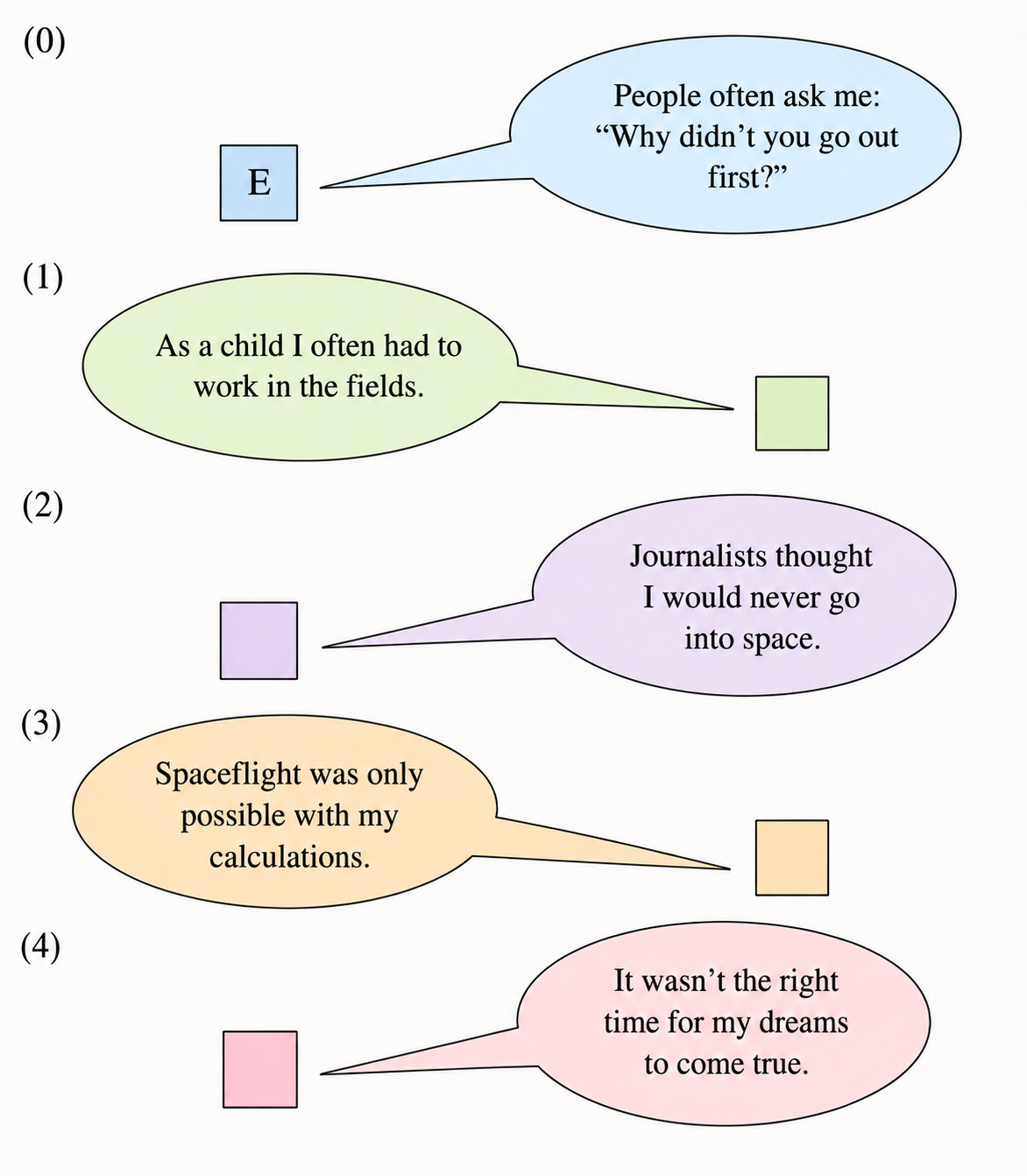
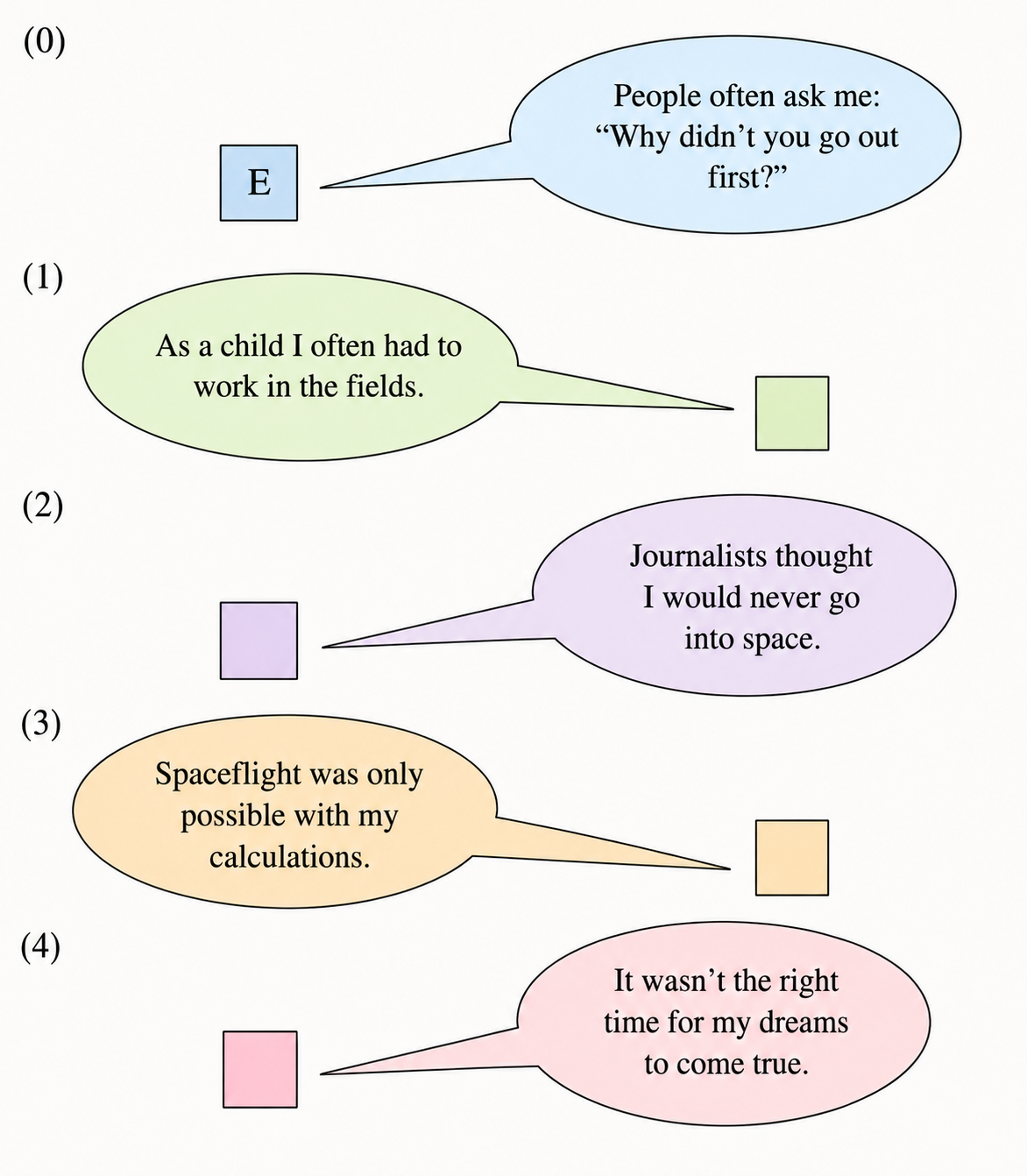
Which person in the text above would have said this? Match the names of the people (A–G) with the statements (1–4). Write the letters in the boxes. Use each letter only once. There are more names than you need.

One name (E) is already matched.

Dorothy

Vaughan

A

John

Glenn

B

Jerry

Cobb

C

Sally

Ride

D

Buzz

Aldrin

E

Neil

Armstrong

F

Valentina

Tereshkova

G

Sprechblasen mit Aussagen über eine Person und farbigen Kästchen.Sprechblasen mit Aussagen über eine Person und farbigen Kästchen.
Sprechblasen mit Aussagen zu einem Raumfahrer und farbigen Kästchen zum Zuordnen.Sprechblasen mit Aussagen zu einem Raumfahrer und farbigen Kästchen zum Zuordnen.
4 Punkte

Task 3

Answer the following questions according to the text above.

Short answers are enough. There is an example (0) at the beginning.

0. What was the biggest TV event in the 1960s? the landing on the moon

1. What does the movie show most realistically?

___________________________________

_____________________________________________________________________________

2. Which country was the first to get a woman into space?

___________________________________

_____________________________________________________________________________

3. What are the two reasons for women being better suited for space-flight?

___________________________________

_____________________________________________________________________________

4. Which qualification did Jerry Cobb lack to become an astronaut?

___________________________________

_____________________________________________________________________________

5. Who was the youngest US woman in space?

___________________________________

_____________________________________________________________________________

6. Where will we probably see a female US astronaut in the future? (Give one example.)

___________________________________

_____________________________________________________________________________

6 Punkte

Task 4

The following words have various meanings. Which of the meanings below is the one used in the text above? Write the correct number in the box.

There is an example (0) at the beginning.

(0) step (line 2)

1

short distance

2

level, grade

3

course of action

4

movement with a foot

4

(1) watch (line 3)

1

look at something over a period of time

2

small timepiece worn on one’s wrist

3

monitor something or somebody

4

shift worked by firefighters

(2) major (line 19)

1

specialize in a subject

2

rank of an officer

3

life-threatening

4

significant

(3) rule (line 36)

1

have a powerful influence on

2

one of a set of regulations

3

control an area or people

4

normal state of things

(4) face (line 46)

1

confront or deal with

2

side of a planet or moon

3

turn in a particular direction

4

front part of a person’s head

4 Punkte
20 Punkte 

Weiter lernen mit SchulLV Plus!

monatlich kündbarSchulLV Plus-Vorteile im ÜberblickDu hast bereits einen Account?

SchulLV