
Pflichtaufgaben
1.1 Analysis
Gegeben sind die in 
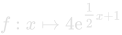
 definierten Funktionen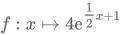
 und
und 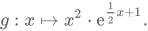
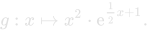
Zeige, dass sich die Graphen von 
 und
und 
 nur für
 und
und 
 schneiden.
Die in definierte Funktion 
 ist eine Stammfunktion von
 Berechne den Inhalt der Fläche, die die Graphen von und einschließen.
1.2 Analysis
Für eine Zahl 
 sind die in definierten Funktionen und mit
 und
und 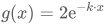
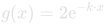 gegeben.
Gib an, wie der Graph von aus dem Graphen von erzeugt werden kann.
Die Graphen von und schneiden sich senkrecht. Bestimme 

1.3 Analytische Geometrie
Gegeben sind die Gerade 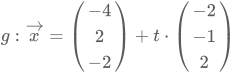
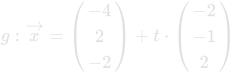 mit
mit 
 und die Ebene

Begründe, dass senkrecht zu 
 steht, und zeige, dass der Punkt
 in liegt.
Bestimme die Koordinaten eines Punktes auf 
 der zu den Abstand
 hat.
hat.
1.4 Stochastik
Betrachtet wird die binomialverteilte Zufallsgröße 
 mit den Parametern
 und
und 

Gib einen Term an, mit dem die Wahrscheinlichkeit 
 berechnet werden kann.
Die Abbildung zeigt die Wahrscheinlichkeitsverteilung von 

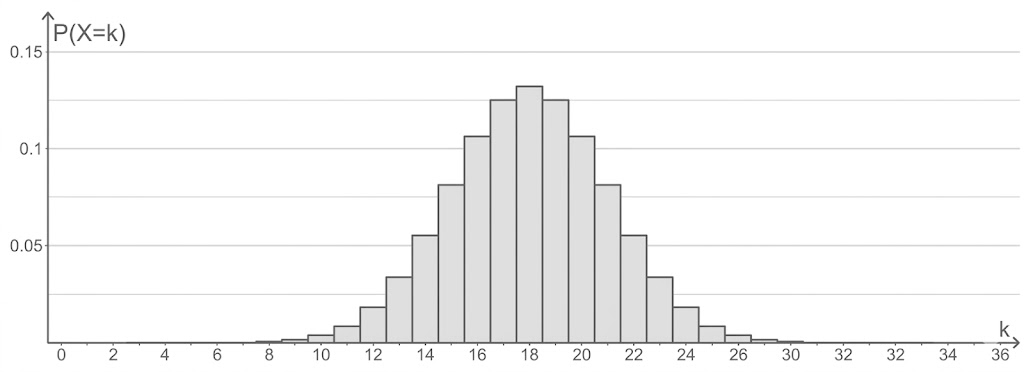
Ermittle einen Näherungswert für 
 wobei
wobei 
 der Erwartungswert und
 die Standardabweichung von sind.
Weiter lernen mit SchulLV Plus!
monatlich kündbarSchulLV Plus-Vorteile im ÜberblickDu hast bereits einen Account?1.1 Analysis
![Formula: \begin{array}{rcll} f(x)&=&g(x)\\[5pt] 4 \mathrm e^{\frac{1}{2}x+1}&=&x^2\cdot \mathrm e^{\tfrac{1}{2}x+1}&\quad\scriptsize\mid : \mathrm e^{\tfrac{1}{2}x+1} \\[5pt] 4&=&x^2 &\quad\scriptsize\mid \sqrt{\; }\\[5pt] \pm2&=&x \end{array}](https://www.schullv.de/resources/formulas/3b55376aadf909c7f21c62297830544e56c0ec11799b5ad7f6236f2aacf1bf22_light.svg)
![Formula: \begin{array}{rcll} f(x)&=&g(x)\\[5pt] 4 \mathrm e^{\frac{1}{2}x+1}&=&x^2\cdot \mathrm e^{\tfrac{1}{2}x+1}&\quad\scriptsize\mid : \mathrm e^{\tfrac{1}{2}x+1} \\[5pt] 4&=&x^2 &\quad\scriptsize\mid \sqrt{\; }\\[5pt] \pm2&=&x \end{array}](https://www.schullv.de/resources/formulas/3b55376aadf909c7f21c62297830544e56c0ec11799b5ad7f6236f2aacf1bf22_dark.svg)
Damit schneiden sich die Graphen nur für 
 und
und 

![Formula: \begin{array}{rcl} A&=&\displaystyle\int_{-2}^{2}\left(f(x)-g(x)\right)\;\mathrm dx\\[5pt] &=&\left[8\mathrm e^{\tfrac{1}{2}x+1}-\left(2x^2-8x+16\right) \mathrm e^{\tfrac{1}{2}x+1}\right]_{-2}^{2}\\[5pt]&=&\left(8 \mathrm e^{\tfrac{1}{2}\cdot2+1}-\left(2\cdot2^2-8\cdot2+16\right) \mathrm e^{\tfrac{1}{2}\cdot2+1}\right)-\left(8 \mathrm e^{\tfrac{1}{2}\cdot(-2)+1}-\left(2\cdot(-2)^2-8\cdot(-2)+16\right) \mathrm e^{\tfrac{1}{2}\cdot(-2)+1}\right)\\[5pt]&=&\left(8 \mathrm e^2-\left(8-16+16\right) \mathrm e^2\right)-\left(8 \mathrm e^0-\left(8+16+16\right)\mathrm e^0\right)\\[5pt]&=&\left(8 \mathrm e^2-8\mathrm e^2\right)-\left(8-40\right)\\[5pt]&=&0-(-32)\\[5pt]&=&32 \end{array}](https://www.schullv.de/resources/formulas/8846cd2bbbd98c78c1d4ac4ef1a9fc588a89a921c1ef4f984d7bf28a846433dc_light.svg)
![Formula: \begin{array}{rcl} A&=&\displaystyle\int_{-2}^{2}\left(f(x)-g(x)\right)\;\mathrm dx\\[5pt] &=&\left[8\mathrm e^{\tfrac{1}{2}x+1}-\left(2x^2-8x+16\right) \mathrm e^{\tfrac{1}{2}x+1}\right]_{-2}^{2}\\[5pt]&=&\left(8 \mathrm e^{\tfrac{1}{2}\cdot2+1}-\left(2\cdot2^2-8\cdot2+16\right) \mathrm e^{\tfrac{1}{2}\cdot2+1}\right)-\left(8 \mathrm e^{\tfrac{1}{2}\cdot(-2)+1}-\left(2\cdot(-2)^2-8\cdot(-2)+16\right) \mathrm e^{\tfrac{1}{2}\cdot(-2)+1}\right)\\[5pt]&=&\left(8 \mathrm e^2-\left(8-16+16\right) \mathrm e^2\right)-\left(8 \mathrm e^0-\left(8+16+16\right)\mathrm e^0\right)\\[5pt]&=&\left(8 \mathrm e^2-8\mathrm e^2\right)-\left(8-40\right)\\[5pt]&=&0-(-32)\\[5pt]&=&32 \end{array}](https://www.schullv.de/resources/formulas/8846cd2bbbd98c78c1d4ac4ef1a9fc588a89a921c1ef4f984d7bf28a846433dc_dark.svg)
Der Inhalt der Fläche, die die Graphen von und einschließen, beträgt 

1.2 Analysis
Der Graph von kann aus dem Graphen von durch Spiegelung an der 
 -Achse erzeugt werden.
![Formula: \begin{array}{rcll} f(x)&=&g(x) \\[5pt] 2 \mathrm e^{k\cdot x}&=&2 \mathrm e^{-k\cdot x} &\quad \scriptsize\mid \;: 2 \\[5pt] \mathrm e^{k \cdot x} &=& \mathrm e^{-k\cdot x} &\quad \scriptsize\mid \; \ln \\[5pt] k \cdot x &=& -k \cdot x &\quad \scriptsize\mid \;+ kx \\[5pt] 2kx &=& 0 &\quad \scriptsize\mid \;:2k \\[5pt] x&=& 0\end{array}](https://www.schullv.de/resources/formulas/aa37bdcc57911295937458e6a966ae13667b182d1efabc1c93d1eb3d6686e831_light.svg)
![Formula: \begin{array}{rcll} f(x)&=&g(x) \\[5pt] 2 \mathrm e^{k\cdot x}&=&2 \mathrm e^{-k\cdot x} &\quad \scriptsize\mid \;: 2 \\[5pt] \mathrm e^{k \cdot x} &=& \mathrm e^{-k\cdot x} &\quad \scriptsize\mid \; \ln \\[5pt] k \cdot x &=& -k \cdot x &\quad \scriptsize\mid \;+ kx \\[5pt] 2kx &=& 0 &\quad \scriptsize\mid \;:2k \\[5pt] x&=& 0\end{array}](https://www.schullv.de/resources/formulas/aa37bdcc57911295937458e6a966ae13667b182d1efabc1c93d1eb3d6686e831_dark.svg)
Für die ersten Ableitungen von und gilt:
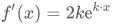


Einsetzen von 
 liefert jeweils:




Da sich die Graphen senkrecht schneiden, muss 
 gelten. Für
 folgt damit:
![Formula: \begin{array}{rcll} f^{\prime}(0) \cdot g^{\prime}(0)&=&-1\\[5pt] 2k\cdot\left(-2k\right)&=&-1\\[5pt] -4k^2&=&-1&\quad\scriptsize\mid\;:(-4)\\[5pt] k^2&=&\dfrac{1}{4}&\quad\scriptsize\mid\; \sqrt{\;} \\[5pt] k&=&\dfrac{1}{2} \end{array}](https://www.schullv.de/resources/formulas/016b2d4e2a658f9fb2b61094d6d65b3728ee1e1e5dc7ff97ab3e1e61046134e2_light.svg)
![Formula: \begin{array}{rcll} f^{\prime}(0) \cdot g^{\prime}(0)&=&-1\\[5pt] 2k\cdot\left(-2k\right)&=&-1\\[5pt] -4k^2&=&-1&\quad\scriptsize\mid\;:(-4)\\[5pt] k^2&=&\dfrac{1}{4}&\quad\scriptsize\mid\; \sqrt{\;} \\[5pt] k&=&\dfrac{1}{2} \end{array}](https://www.schullv.de/resources/formulas/016b2d4e2a658f9fb2b61094d6d65b3728ee1e1e5dc7ff97ab3e1e61046134e2_dark.svg)
1.3 Analytische Geometrie
Lage von 
 begründen
Der Vektor 
 ist sowohl Richtungsvektor von als auch Normalenvektor von
 somit steht senkrecht zu

Lage von 
 zeigen
Einsetzen der Koordinaten von 
 in die Ebenengleichung von ergibt:


Somit liegt in
Der Ortsvektor von ergibt sich durch den Punkt 
 der nach Teilaufgabe a in liegt. Für die Länge des Richtungsvektors von gilt:
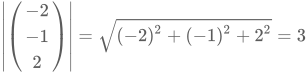
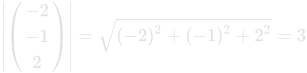
Da der Richtungsvektor von orthogonal zu steht, liefert 
 den Ortsvektor eines geeigneten Punktes:
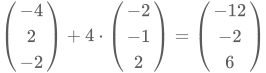
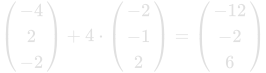
Die Koordinaten des gesuchten Punktes sind somit z.B. gegeben durch 

1.4 Stochastik
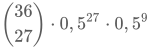
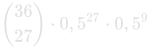
Es gilt:
![Formula: \begin{array}[t]{rlll} \mu&=&n\cdot p \\[5pt] &=&36\cdot0,5 \\[5pt] &=&18 \end{array}](https://www.schullv.de/resources/formulas/fcadf1e7b865b643d4ec6641c58800d4e0748d499dde2767ad675dfe5061ad5d_light.svg)
![Formula: \begin{array}[t]{rlll} \mu&=&n\cdot p \\[5pt] &=&36\cdot0,5 \\[5pt] &=&18 \end{array}](https://www.schullv.de/resources/formulas/fcadf1e7b865b643d4ec6641c58800d4e0748d499dde2767ad675dfe5061ad5d_dark.svg)
![Formula: \begin{array}[t]{rlll} \sigma&=&\sqrt{n\cdot p\cdot (1-p)} \\[5pt] &=&\sqrt{18\cdot0,5} \\[5pt] &=&3 \end{array}](https://www.schullv.de/resources/formulas/81a8680219c5f57a615e5f850109fe55c317bc4239cd6c5c81ee2473cfcb9c50_light.svg)
![Formula: \begin{array}[t]{rlll} \sigma&=&\sqrt{n\cdot p\cdot (1-p)} \\[5pt] &=&\sqrt{18\cdot0,5} \\[5pt] &=&3 \end{array}](https://www.schullv.de/resources/formulas/81a8680219c5f57a615e5f850109fe55c317bc4239cd6c5c81ee2473cfcb9c50_dark.svg)
Damit ergibt sich:
![Formula: \begin{array}[t]{rlll} P(\mu-0,5 \cdot \sigma \leq X \leq \mu+0,5 \cdot \sigma)&=&P(17 \leq X \leq 19) \\[5pt] &\approx&0,13+2\cdot0,125 \\[5pt] &=&0,38 \\[5pt] &=&38\,\% \end{array}](https://www.schullv.de/resources/formulas/92ff2870c99177f4592403f63c59e8c573e5b9f2015295362f1e2649f34e7305_light.svg)
![Formula: \begin{array}[t]{rlll} P(\mu-0,5 \cdot \sigma \leq X \leq \mu+0,5 \cdot \sigma)&=&P(17 \leq X \leq 19) \\[5pt] &\approx&0,13+2\cdot0,125 \\[5pt] &=&0,38 \\[5pt] &=&38\,\% \end{array}](https://www.schullv.de/resources/formulas/92ff2870c99177f4592403f63c59e8c573e5b9f2015295362f1e2649f34e7305_dark.svg)