
A – Pflichtaufgaben
1 Analysis (Pflichtaufgabe – Niveau 1)
Für eine Zahl 
 sind die in
 definierten Funktionen
 und
und 
 mit
mit 
 und
und 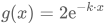
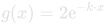 gegeben.
Gib an, wie der Graph von aus dem Graphen von erzeugt werden kann.
Die Graphen von und schneiden sich senkrecht. Bestimme 

2 Analysis (Pflichtaufgabe – Niveau 1)
Gegeben sind die in definierten Funktionen 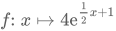
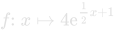 und
und 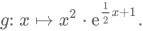
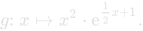
Zeige, dass sich die Graphen von und nur für 
 und
und 
 schneiden.
Die in definierte Funktion 
 ist eine Stammfunktion von

Berechne den Inhalt der Fläche, die die Graphen von und einschließen.
3 Lineare Algebra / Analytische Geometrie (Pflichtaufgabe – Niveau 1)
Gegeben sind die Gerade 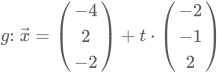
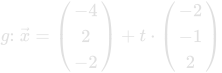 mit
mit 
 und die Ebene

Begründe, dass senkrecht zu 
 steht, und zeige, dass der Punkt
 in liegt.
Bestimme die Koordinaten eines Punktes auf 
 der zu den Abstand
 hat.
hat.
4 Stochastik (Pflichtaufgabe – Niveau 1)
Betrachtet wird die binomialverteilte Zufallsgröße 
 mit den Parametern
 und
und 

Gib einen Term an, mit dem die Wahrscheinlichkeit 
 berechnet werden kann.
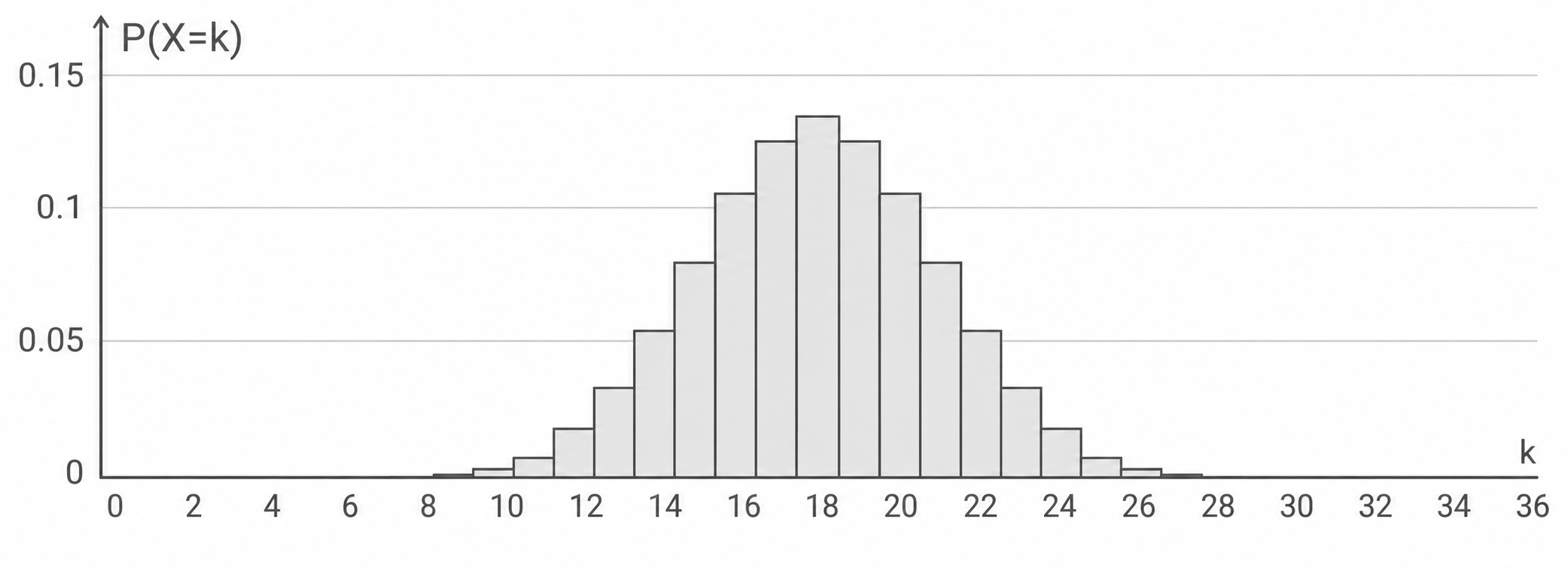
Das Material zeigt die Wahrscheinlichkeitsverteilung von 

Ermittle einen Näherungswert für 
 wobei
wobei 
 der Erwartungswert und
 die Standardabweichung von sind.
Weiter lernen mit SchulLV Plus!
monatlich kündbarSchulLV Plus-Vorteile im ÜberblickDu hast bereits einen Account?1 Analysis (Pflichtaufgabe – Niveau 1)
Es gilt: 

Der Graph von kann also aus dem Graphen von durch Spiegelung an der 
 Achse erzeugt
werden.
Berechnung der Schnittstelle durch Gleichsetzen:
![Formula: \begin{array}{rcll} 2\mathrm{e}^{k\cdot x}&=&2\mathrm{e}^{-k\cdot x} &\quad \mid \div 2 \\[5pt] \mathrm{e}^{k \cdot x} &=& \mathrm{e}^{-k\cdot x} &\quad \mid \, \ln \left( \ \right) \\[5pt] k \cdot x &=& -k \cdot x &\quad \mid + \left( k \cdot x \right) \\[5pt] 2 \cdot k \cdot x &=& 0 &\quad \mid \div \left(2 \cdot k \right) &\quad \left( k > 0 \right) \\[5pt] x&=& 0\end{array}](https://www.schullv.de/resources/formulas/3f1a7da681411d72f0179761ab28b5c3a209181b5ab2a812dbb3d85efbfa6360_light.svg)
![Formula: \begin{array}{rcll} 2\mathrm{e}^{k\cdot x}&=&2\mathrm{e}^{-k\cdot x} &\quad \mid \div 2 \\[5pt] \mathrm{e}^{k \cdot x} &=& \mathrm{e}^{-k\cdot x} &\quad \mid \, \ln \left( \ \right) \\[5pt] k \cdot x &=& -k \cdot x &\quad \mid + \left( k \cdot x \right) \\[5pt] 2 \cdot k \cdot x &=& 0 &\quad \mid \div \left(2 \cdot k \right) &\quad \left( k > 0 \right) \\[5pt] x&=& 0\end{array}](https://www.schullv.de/resources/formulas/3f1a7da681411d72f0179761ab28b5c3a209181b5ab2a812dbb3d85efbfa6360_dark.svg)
Berechnung der Steigungen der beiden Graphen im Schnittpunkt:
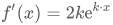


Für 
 gilt:
gilt:




Da sich die Graphen senkrecht schneiden, muss für die Steigungen gelten: 

Damit folgt für 

![Formula: \begin{array}{rcll} 2k\cdot\left(-2k\right)&=&-1\\[5pt] -4k^2&=&-1&\quad\mid \div(-4)\\[5pt] k^2&=&\dfrac{1}{4}&\quad\mid \sqrt{\ }\\[5pt] k&=&\dfrac{1}{2}&\quad(k>0) \end{array}](https://www.schullv.de/resources/formulas/88eff99f66d776e9758d2230d9fdb01c489b51b939f3e039436135db8111d65d_light.svg)
![Formula: \begin{array}{rcll} 2k\cdot\left(-2k\right)&=&-1\\[5pt] -4k^2&=&-1&\quad\mid \div(-4)\\[5pt] k^2&=&\dfrac{1}{4}&\quad\mid \sqrt{\ }\\[5pt] k&=&\dfrac{1}{2}&\quad(k>0) \end{array}](https://www.schullv.de/resources/formulas/88eff99f66d776e9758d2230d9fdb01c489b51b939f3e039436135db8111d65d_dark.svg)
2 Analysis (Pflichtaufgabe – Niveau 1)
Berechnung der Schnittstellen durch Gleichsetzen:
![Formula: \begin{array}{rcll} f(x)&=&g(x)\\[5pt] 4\mathrm{e}^{\frac{1}{2}x+1}&=&x^2\cdot \mathrm{e}^{\frac{1}{2}x+1}&\quad\mid \div \mathrm{e}^{\frac{1}{2}x+1}\quad \bigl(\mathrm{e}^{\frac{1}{2}x+1}>0\text{ für alle }x\in\mathbb{R}\bigr)\\[5pt] 4&=&x^2&\quad\mid \sqrt{\ }\\[5pt] x&=&\pm 2\\[5pt] x_1&=&-2\\[5pt] x_2&=&2 \end{array}](https://www.schullv.de/resources/formulas/f746da832ca4920cbb729e35ee96fc8e0ca271553e59914890bb66757cbe6017_light.svg)
![Formula: \begin{array}{rcll} f(x)&=&g(x)\\[5pt] 4\mathrm{e}^{\frac{1}{2}x+1}&=&x^2\cdot \mathrm{e}^{\frac{1}{2}x+1}&\quad\mid \div \mathrm{e}^{\frac{1}{2}x+1}\quad \bigl(\mathrm{e}^{\frac{1}{2}x+1}>0\text{ für alle }x\in\mathbb{R}\bigr)\\[5pt] 4&=&x^2&\quad\mid \sqrt{\ }\\[5pt] x&=&\pm 2\\[5pt] x_1&=&-2\\[5pt] x_2&=&2 \end{array}](https://www.schullv.de/resources/formulas/f746da832ca4920cbb729e35ee96fc8e0ca271553e59914890bb66757cbe6017_dark.svg)
Damit schneiden sich die Graphen nur für 
 und
und 

Eine Stammfunktion von ist: 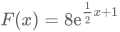
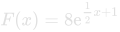
Für den gesuchten Flächeninhalt gilt:
![Formula: \begin{array}{rcl} A&=&\displaystyle\int_{-2}^{2}\bigl(f(x)-g(x)\bigr)\,dx\\[5pt]&=&\bigl[F(x)-G(x)\bigr]_{-2}^{2}\\[5pt]&=&\left[8\mathrm{e}^{\frac{1}{2}x+1}-\left(2x^2-8x+16\right)\mathrm{e}^{\frac{1}{2}x+1}\right]_{-2}^{2}\\[5pt]&=&\left(8\mathrm{e}^{\frac{1}{2}\cdot2+1}-\left(2\cdot2^2-8\cdot2+16\right)\cdot\mathrm{e}^{\frac{1}{2}\cdot2+1}\right)\\[5pt]&&-\left(8\mathrm{e}^{\frac{1}{2}\cdot(-2)+1}-\left(2\cdot(-2)^2-8\cdot(-2)+16\right)\cdot\mathrm{e}^{\frac{1}{2}\cdot(-2)+1}\right)\\[5pt]&=&\left(8\mathrm{e}^2-\left(8-16+16\right)\cdot\mathrm{e}^2\right)-\left(8\mathrm{e}^0-\left(8+16+16\right)\cdot\mathrm{e}^0\right)\\[5pt]&=&\left(8\mathrm{e}^2-8\mathrm{e}^2\right)-\left(8-40\right)\\[5pt]&=&0-(-32)\\[5pt]&=&32 \end{array}](https://www.schullv.de/resources/formulas/3e8be11029e3666fba94eb44d9606c5b2da3ae9bc0df3af8794096dc205099dc_light.svg)
![Formula: \begin{array}{rcl} A&=&\displaystyle\int_{-2}^{2}\bigl(f(x)-g(x)\bigr)\,dx\\[5pt]&=&\bigl[F(x)-G(x)\bigr]_{-2}^{2}\\[5pt]&=&\left[8\mathrm{e}^{\frac{1}{2}x+1}-\left(2x^2-8x+16\right)\mathrm{e}^{\frac{1}{2}x+1}\right]_{-2}^{2}\\[5pt]&=&\left(8\mathrm{e}^{\frac{1}{2}\cdot2+1}-\left(2\cdot2^2-8\cdot2+16\right)\cdot\mathrm{e}^{\frac{1}{2}\cdot2+1}\right)\\[5pt]&&-\left(8\mathrm{e}^{\frac{1}{2}\cdot(-2)+1}-\left(2\cdot(-2)^2-8\cdot(-2)+16\right)\cdot\mathrm{e}^{\frac{1}{2}\cdot(-2)+1}\right)\\[5pt]&=&\left(8\mathrm{e}^2-\left(8-16+16\right)\cdot\mathrm{e}^2\right)-\left(8\mathrm{e}^0-\left(8+16+16\right)\cdot\mathrm{e}^0\right)\\[5pt]&=&\left(8\mathrm{e}^2-8\mathrm{e}^2\right)-\left(8-40\right)\\[5pt]&=&0-(-32)\\[5pt]&=&32 \end{array}](https://www.schullv.de/resources/formulas/3e8be11029e3666fba94eb44d9606c5b2da3ae9bc0df3af8794096dc205099dc_dark.svg)
Der Inhalt der Fläche, die die Graphen von und einschließen, beträgt 

3 Lineare Algebra / Analytische Geometrie (Pflichtaufgabe – Niveau 1)
Der Richtungsvektor der Geraden ist

Aus der Koordinatengleichung der Ebene lässt sich der Normalenvektor ablesen:


Da 
 und
und 
 übereinstimmen, steht die Gerade senkrecht zur Ebene

Um zu zeigen, dass der Punkt 
 in der Ebene liegt, werden seine Koordinaten in die Ebenengleichung eingesetzt:
![Formula: \begin{array}{rcll} -2 \cdot (-4) - 2 + 2 \cdot (-2) -2 &=& 0 \\[5pt] 8-2-4-2 &=& 0 \\[5pt] 0 &=& 0 \end{array}](https://www.schullv.de/resources/formulas/13a7abefffb09a4d3c88285969b7428ed375d7be70aeaefa1fa16d9d80ca59f6_light.svg)
![Formula: \begin{array}{rcll} -2 \cdot (-4) - 2 + 2 \cdot (-2) -2 &=& 0 \\[5pt] 8-2-4-2 &=& 0 \\[5pt] 0 &=& 0 \end{array}](https://www.schullv.de/resources/formulas/13a7abefffb09a4d3c88285969b7428ed375d7be70aeaefa1fa16d9d80ca59f6_dark.svg)
Damit liegt der Punkt in der Ebene
Da der Stützpunkt der Geraden ist und zugleich in der Ebene liegt, ist er der Schnittpunkt von und Da die Gerade zudem senkrecht auf der Ebene steht, verläuft die kürzeste Verbindung eines Punktes 
 der Geraden
 zur Ebene entlang der Geraden .
Der Richtungsvektor der Geraden hat die Länge:


Ein Punkt auf der Geraden hat die Form:
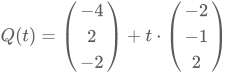
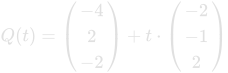
Der Abstand von 
 zur Ebene beträgt daher:


Dieser Abstand soll sein:
![Formula: \begin{array}{rcll} \left| t \right| \cdot 3 &=& 12 &\quad \mid \div 3 \\[5pt] \left| t \right| &=& 4 \end{array}](https://www.schullv.de/resources/formulas/2ddb0dd3cc003e6cc18a1d19a50cdfe5642b02b72781d68c33ce2d3314dd3dbc_light.svg)
![Formula: \begin{array}{rcll} \left| t \right| \cdot 3 &=& 12 &\quad \mid \div 3 \\[5pt] \left| t \right| &=& 4 \end{array}](https://www.schullv.de/resources/formulas/2ddb0dd3cc003e6cc18a1d19a50cdfe5642b02b72781d68c33ce2d3314dd3dbc_dark.svg)
Damit ist 
 oder
oder 
 möglich. Es genügt, einen der beiden Werte zu wählen.
Mit erhält man:
![Formula: \begin{array}{rcll} Q(4) &=& \begin{pmatrix} -4 \\ 2 \\ -2 \end{pmatrix} + 4 \cdot \begin{pmatrix} - 2 \\ -1 \\ 2 \end{pmatrix} \\[5pt] &=& \begin{pmatrix} -4 \\ 2 \\ -2 \end{pmatrix} + \begin{pmatrix} - 8 \\ -4 \\ 8 \end{pmatrix} \\[5pt] &=& \begin{pmatrix} -12 \\ -2 \\ 6 \end{pmatrix} \end{array}](https://www.schullv.de/resources/formulas/2d477a674e5f5d5d74bc73d00b35646b6f306b5ca6d7ab54a2d44d2444180c57_light.svg)
![Formula: \begin{array}{rcll} Q(4) &=& \begin{pmatrix} -4 \\ 2 \\ -2 \end{pmatrix} + 4 \cdot \begin{pmatrix} - 2 \\ -1 \\ 2 \end{pmatrix} \\[5pt] &=& \begin{pmatrix} -4 \\ 2 \\ -2 \end{pmatrix} + \begin{pmatrix} - 8 \\ -4 \\ 8 \end{pmatrix} \\[5pt] &=& \begin{pmatrix} -12 \\ -2 \\ 6 \end{pmatrix} \end{array}](https://www.schullv.de/resources/formulas/2d477a674e5f5d5d74bc73d00b35646b6f306b5ca6d7ab54a2d44d2444180c57_dark.svg)
Ein möglicher Punkt auf der zur Ebene den Abstand hat, ist also 

4 Stochastik (Pflichtaufgabe – Niveau 1)


Für den Erwartungswert und die Standardabweichung gilt:




Gesucht ist also 

Da die Zufallsgröße nur ganze Werte annehmen kann, gilt:

Aus dem Diagramm lässt sich näherungsweise ablesen:






Damit gilt


also 
